Parsing
约 3167 个字 19 行代码 29 张图片 预计阅读时间 32 分钟
参考笔记
本章可对照 HowJul 语雀笔记的 第 3 章:语法分析、语法分析自顶向下、语法分析自底向上,以及 Cubic Y³ 的 Part 3-6: 语法分析。
Overview
-
Syntax: the way in which words are put together to form phrases, clauses, or sentences.
-
Syntax analysis: parsing the phrase structure of the program
The parser is constructed based on the grammar, and extracts abstract syntax from a stream of tokens
非常重要 !!:语法分析要干 两件事:
- 能够根据给定的语法规则正确判断给定的词法分析器给出的 token 序列是否合法
- 能根据 token stream 构造出一个 parse tree
Tip
Above code segment has no lexical errors, but multiple syntax errors.
Outline
这一章内容围绕着 How to build a parser ? 这个问题来展开,将要按照以下流程来做出一个语法分析器
- Specifying the syntax of a programming language with Context-Free Grammar (CFG)
- Build the parser based on the CFG:
- Top-Down Parsing
- Predictive Parsing (LL(k) Parsing)
- Bottom-Up Parsing
- More about parsing:
- Automatic Parser Generation
- Error Recovery
Context-Free Grammar
CFG 在计算理论中也已经学习过了,简单回顾一下:
A CFG consists of:
- A set of terminals \(T\): symbols from the alphabet (lexical tokens)
- A set of non-terminals \(N\)
- A start symbol \(S \in N\)
- A set of productions (rules)
- X -> Y1 Y2 ... Yk (replace X with Y1 Y2 ... Yk)
A string is in L(G) iff is possible to derive that string from the start symbol S.
一个简单代码的语法可以用如下的 CFG 来表示:
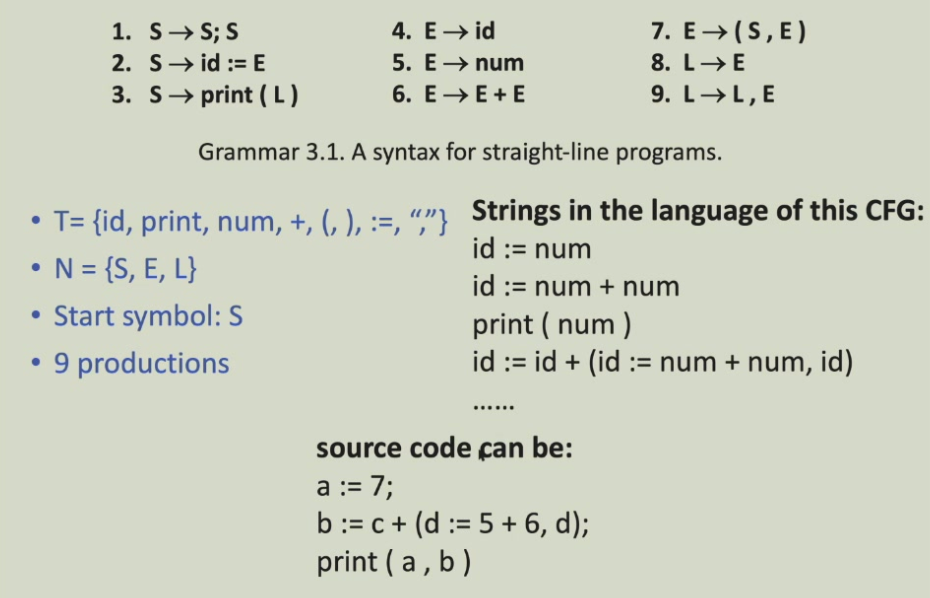
此外,我们还可以发现完整的推导 (derivation) 过程可以被描述成一颗树:
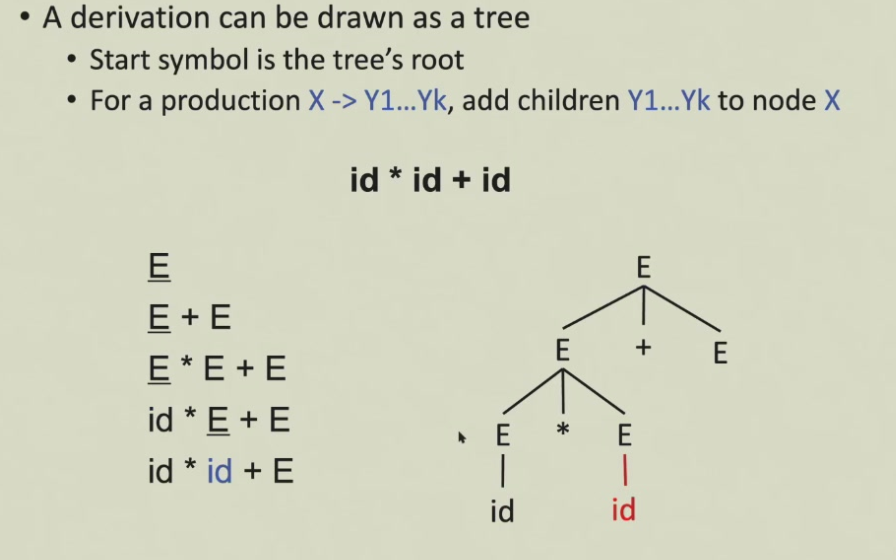
Note
E 表示的是下一步 derivation 将从这个 Non-Terminals 开始
The above example is a left-most derivation
- at each step, replace the left-most non-terminal
- There is also an equivalent notion of a right-most derivation ( 也就是总是从最右边的非终结符往下推导 )
Important
- A parse tree has
- Terminals at the leaves
- Non-terminals at the interior nodes
- An in-order traversal of the leaves is the original input
- The parse tree shows the association of operations, the input string does not ( 树状结构隐含了更多信息,比如 * 比 + 更深,这蕴含了运算优先级的信息;而单纯的字符串则不能看出运算优先级,包含歧义)
可以发现,CFG 可能会存在 Ambiguity(二义性)的问题,比如先前那个 CFG 在处理 id * id + id 就会出现两种不同的树
为此可以采用重写 CFG 的方式,例如下图:
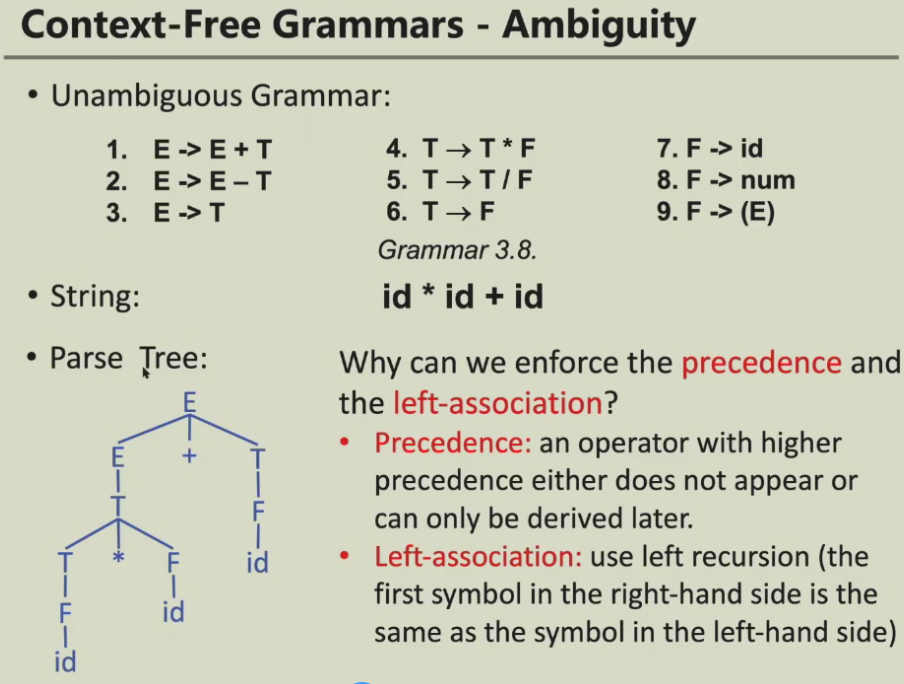
这套文法里:
E:大表达式,处理加减T:中表达式,处理乘除F:最小单位,处理原子对象F → (E):允许“一个完整表达式”被括号包起来,降级成一个最小单位
更高优先级的运算总是在更后面推导;递归推导总是将原非终结符放在最左边
Important
There are some languages that have ambiguous grammars but no unambiguous grammar, such languages may be problematic as programming languages
比如日常使用的口头语言,就是有二义性的,我们无法用一个没有二义性的 grammar 来表示它们
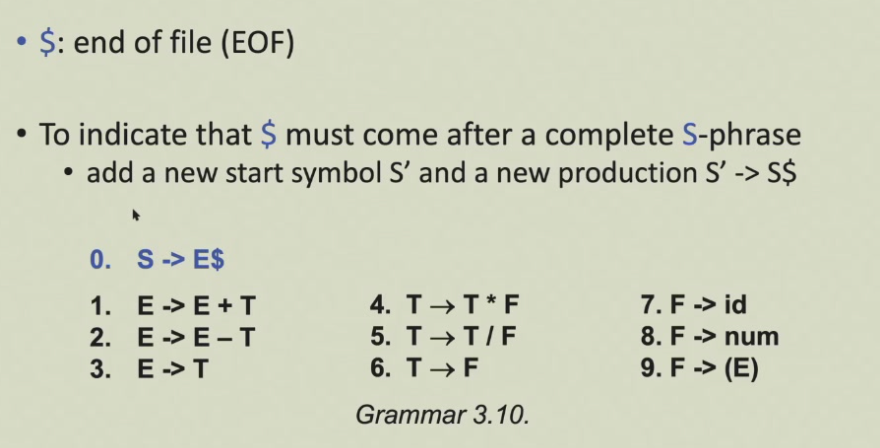
最后,我们的文法规则还应该告诉语法分析器输入在什么时候终止,为此需要引入一个特殊的 $ 标记
当我们规定 S -> E $ 后,意思是一个合法输入必须是一个完整的表达式 + 输入结束符
Top-Down Parsing
给定 CFG 后,我们开始基于 CFG 构造语法分析器,存在两种构造方法:
- Top-Down Parsing
- Predictive Parsing (LL(k) Parsing)
- Bottom-Up Parsing
我们先介绍前者 Top-Down Parsing
首先,programming language 属于 CFG 的一个子类,我们不需要编写一个能够解析所有 CFG 文法的 parser,只需要做一个支持特定文法的编译器即可:
-
Parsing all CFGS in one compiler is expensive
-
algorithms for parsing all CFGs are expensive
-
sometimes 1/3 of compilation time is spent in parsing
-
-
Compiler writers have developed specialized algorithms for parsing the kinds of CFGs that you need to build effective programming languages
Note
我们通常采用 Recursive Descent Parsing (top-down parsing, predictive parsing) 的 parsing 范式:
- simple, can be coded by hand
- parses many, but not all CFGs
- parse LL(1) grammars: Left-to-right parse, Leftmost-derivation; 1 symbol lookahead
Important
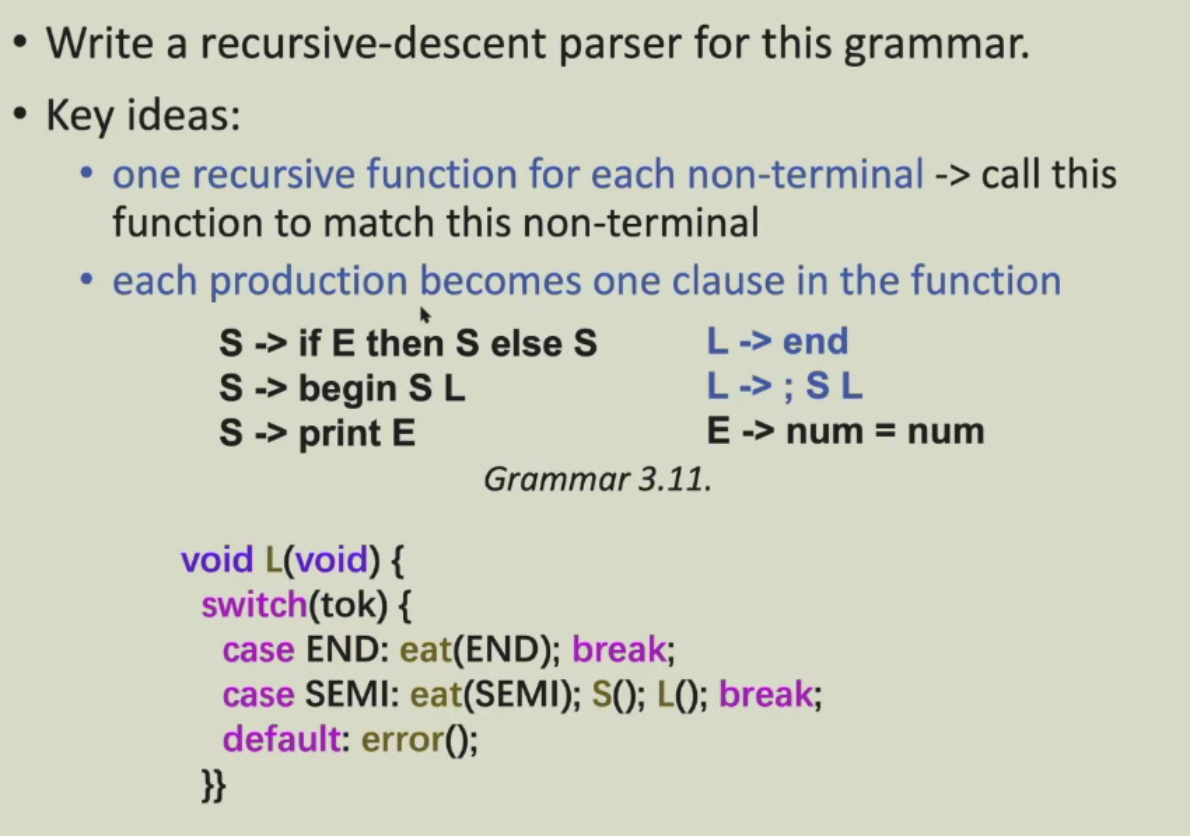
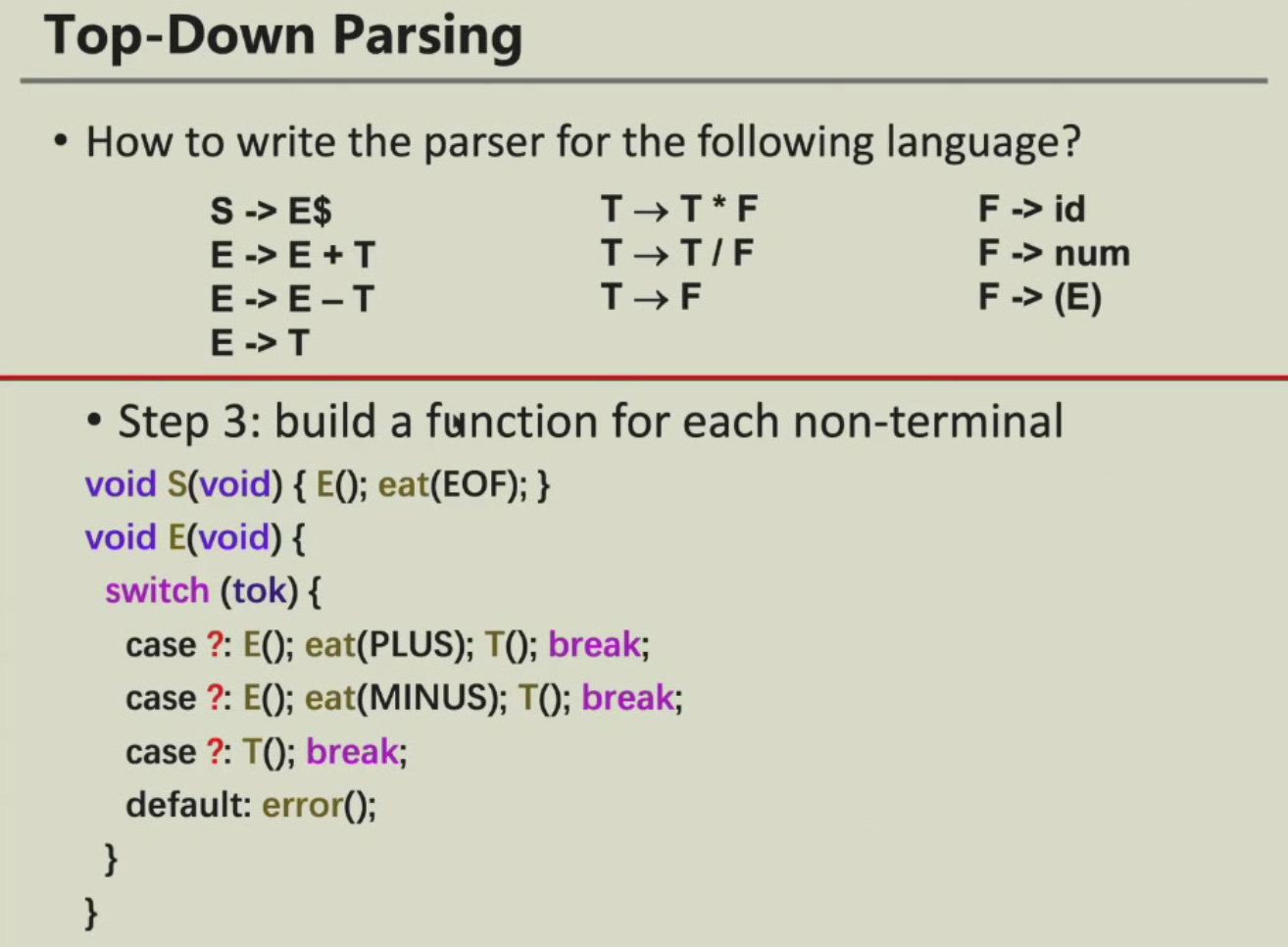
从上方的两个例子可以看出
- 当文法所有推导式的右侧都以终结符开头,可以非常简单的实现 top-down 的 parser:只需要对每一个 non-terminal 编写一个递归函数即可
- 反之,当文法稍微复杂起来,就没办法写 E 的语法分析函数了,就需要做预测分析了
Predictive Parsing
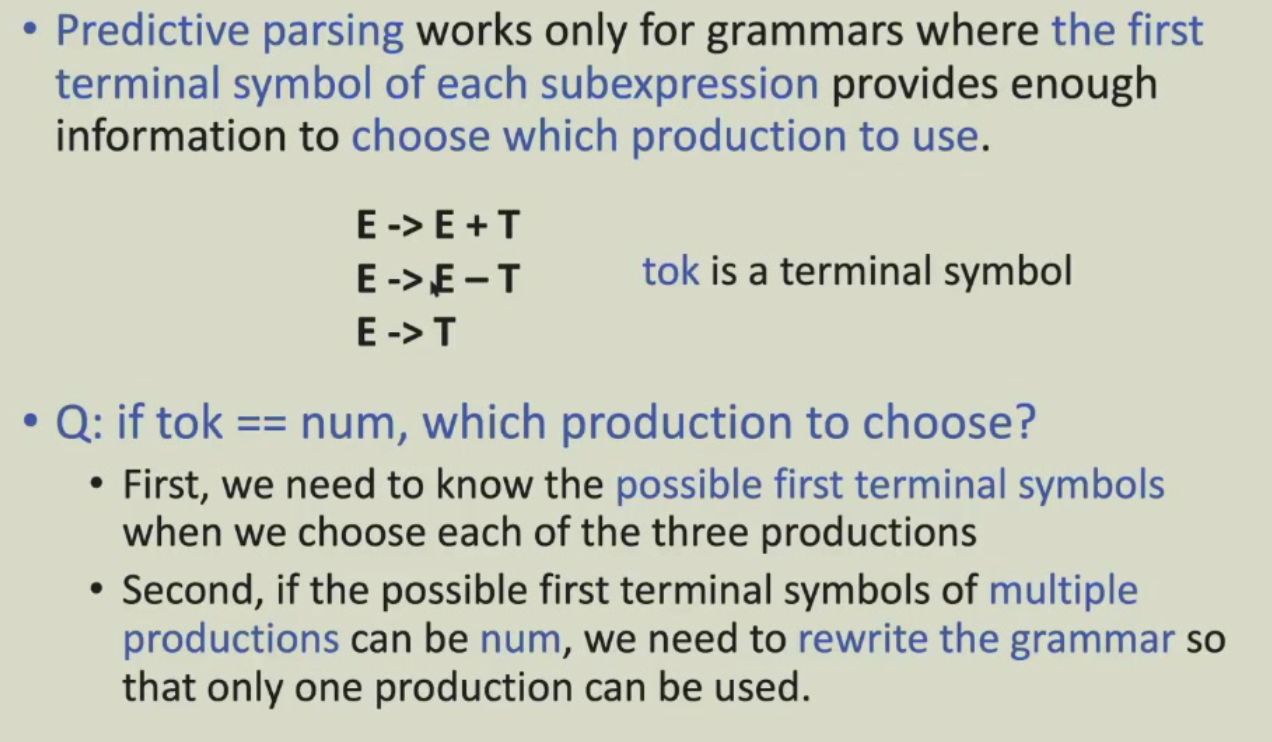
首先引入两个 Predictive Parsing 中重要的工具:
-
FIRST(\(\gamma\)): \(\gamma\) 能推出的字符串中,可能出现的第一个终结符的集合
- 例子:T -> F; F-> id | (E)
- 则 FIRST(F) = { id, ( }; FIRST(T) = { id, ( }
-
FOLLOW(X): 在从 S 开始的某些推导中,X 后面可能紧跟的终结符集合
简而言之
- FIRST 看的是“我自己展开后,开头会是什么
? ” - FOLLOW 看的是“我在别的产生式出现时,右边可能跟的是谁
? ”
Important
Consider non-terminal \(X\), production \(X \rightarrow \gamma\), possible first terminal symbol \(t\) can be:
- any token in FIRST(\(\gamma\))
- any token in FOLLOW(\(X\)) if \(\gamma \rightarrow^*\epsilon\)
换句话来说:如果 token == num,我们应该选择哪条 production 呢?
答案是:可以选择 \(X \rightarrow \gamma\) 这条产生式,当
- 情况 1:\(\text{token} \in \text{FIRST}(\gamma)\) (注意:情况 1 的本质是 \(\gamma\) 可以正常第一个地产生当前 token)
- 情况 2:\(\gamma \rightarrow^* \epsilon\) 且 \(\text{token} \in \text{FOLLOW}(X)\) (注意:情况 2 的本质是如果 \(\gamma\) 可以为空,就看当前 token 是否属于 X 后面可以出现的东西)
First 和 Follow 的计算方式如下:
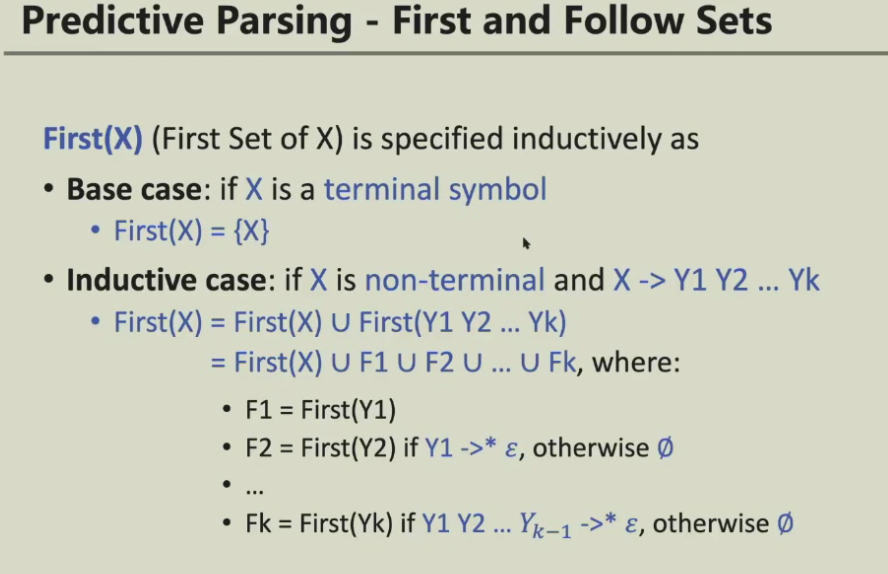
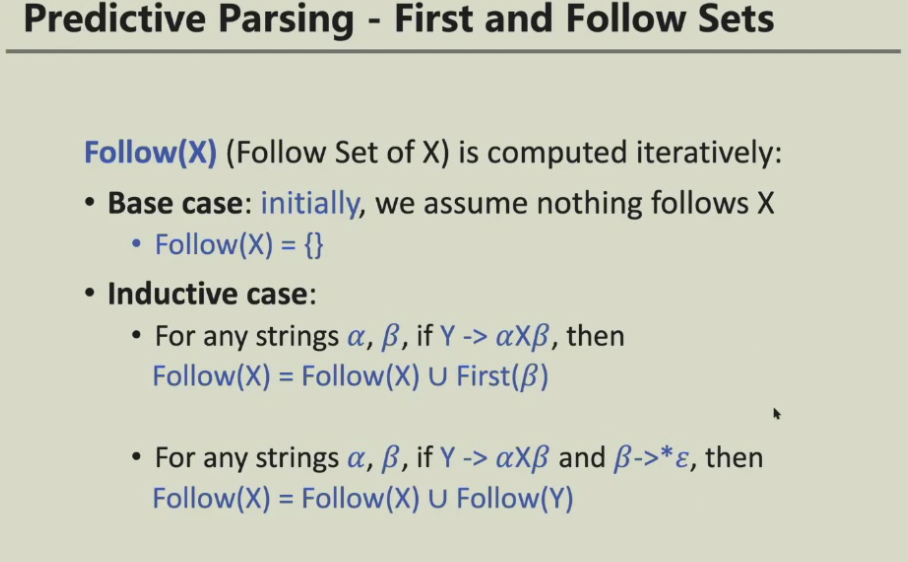
可以发现,某一个非终结符能不能推出空串,对于我们计算 Follow 和 First 非常重要。
因此我们定义一个 Nullable 函数:
-
Nullable(X) = True if \(X \rightarrow^*\epsilon\)
-
Algorithm:
for each symbol X:
repeat:
  Nullable(X) = False
  for each production X -> Y1 Y2 ... Yk:
      if Nullable(Yi) = True for all 1<= i <=k;
          Nullable(X) = True
until Nullable did not change in this iteration
上面这一坨 First/Follow/Nullable 计算的东西没太看懂也不重要,最重要的是学懂下面给出的这个例子,非常适合拿来做考试题
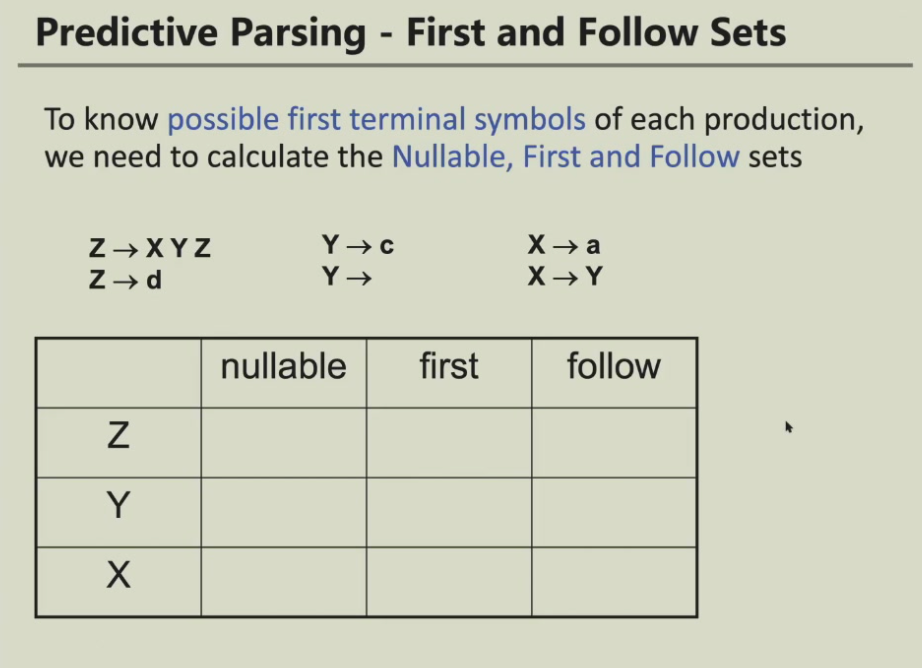
这里完整过程可以直接看 2025 年的智云回放
答案如下:
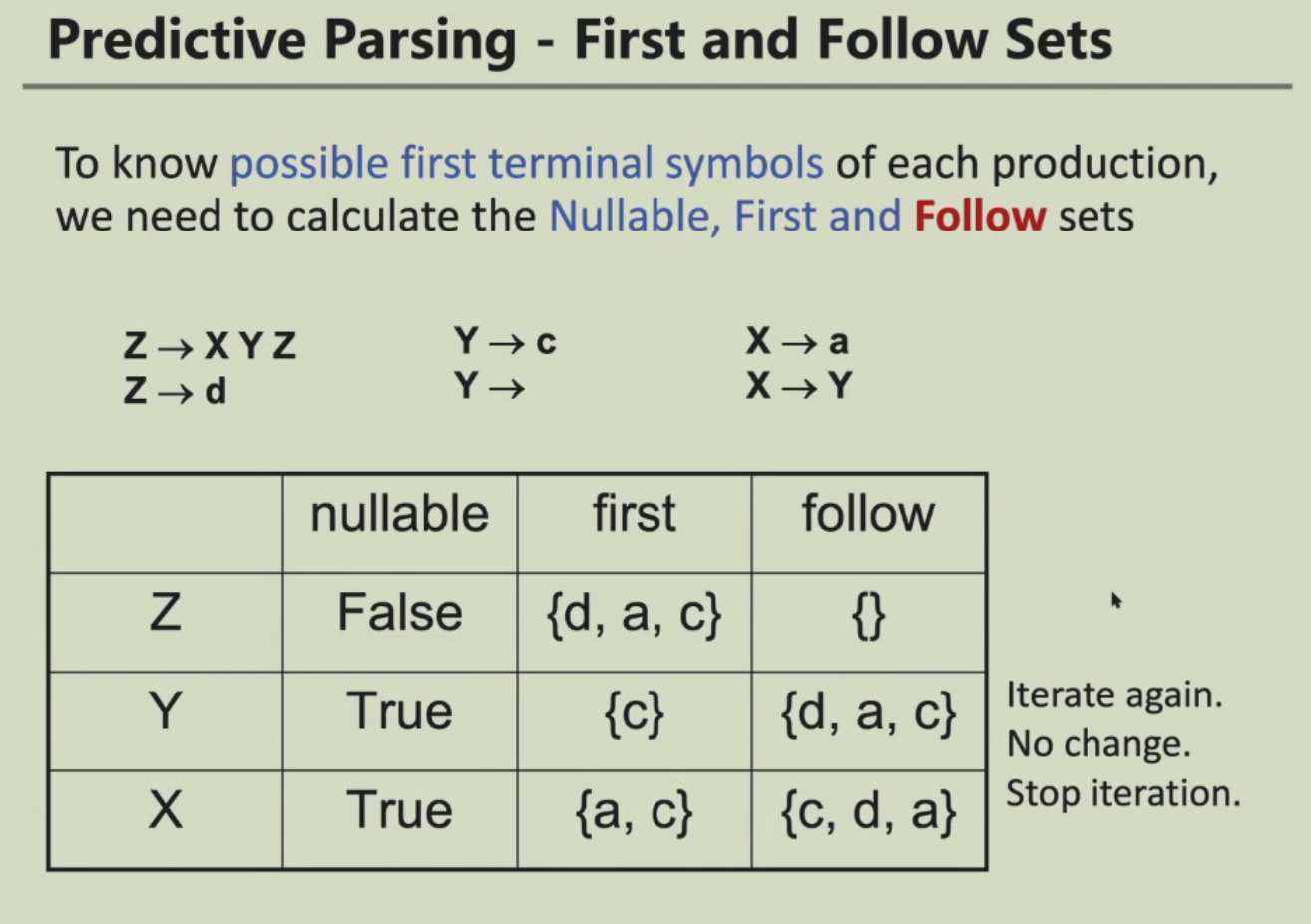
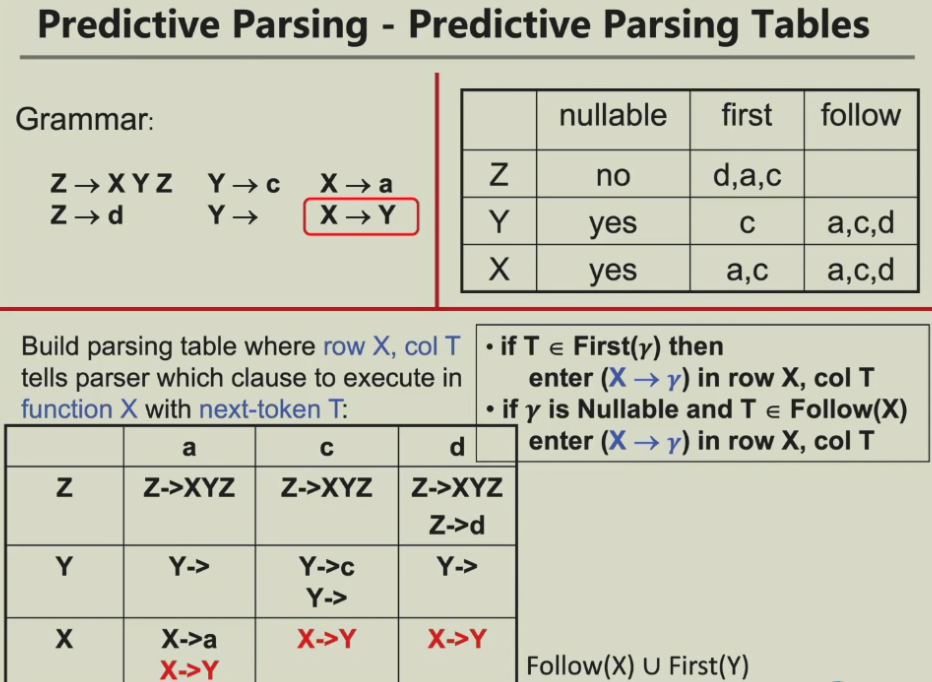
有了所有非终结符的这一张 Nullable/First/Follow Table 后,我们就可以构造语法分析所需要的一张 Parsing Table(语法分析表
Tip
回顾一下,词法分析是依据词法规则(借助 DFA)给我们一堆 token 串,而语法分析是将这些 token 串根据语法规则(借助 CFG)判断 token 串是否符合语法规则并给出一个 parsing tree
接下来继续以上述的 Grammar 为例来构造 Parsing Table,下图中的 Row (Non-terminal) - Column (terminal) 中填入的是语法生成式,描述的是在语法解析过程中,当遇到某个 terminal 时,可能会用哪一条语法生成式生成它:
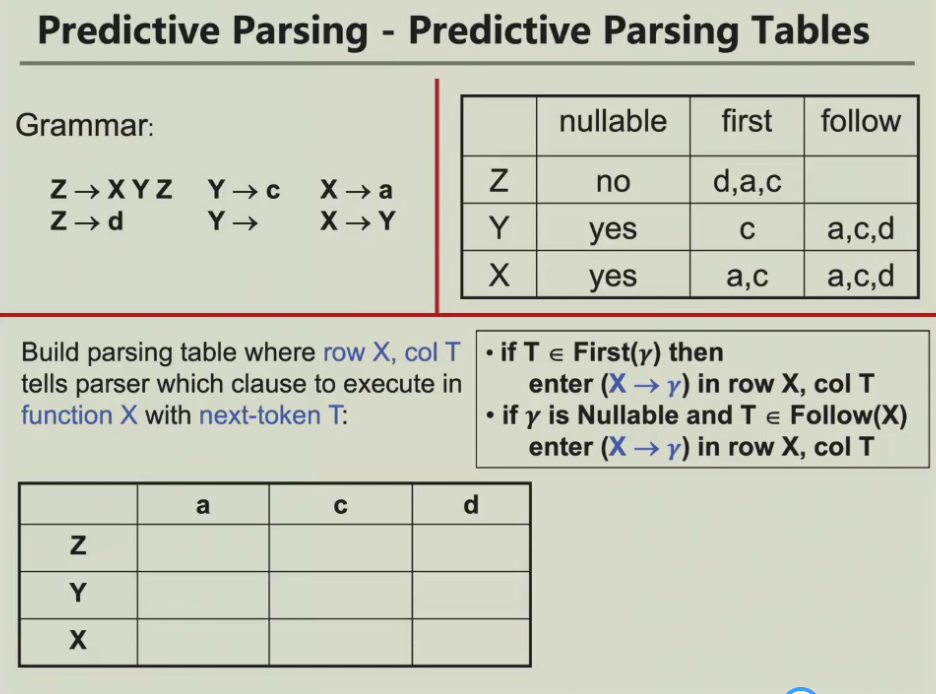
同样可以去看 2025 年智云 来理解 Build Parsing Table 的过程,最后结果如下:
Important
对于最后的 Parsing Table,我们可以思考两个问题:
- 如果有一个格子为空,没有一条产生式:意味着如果在此时遇到该 terminal 会产生语法错误
- 如果有一个格子存在两条产生式:意味着存在存在多重定义的项,对语法分析不太友好
这也就引入了接下来的 LL(1) grammar
LL(1) grammar
-
LL(1) grammar: the so-obtained predictive parsing table contains no duplicate entries
- Left-to-right parse, Left-most derivation, 1 symbol lookahead
-
if not, the grammar is not LL(1)
-
In LL(k) parsing tables, columns include every k-length sequence of terminals:
aa ab ba bb ac ca ...
Tip
LL(k) 意思是往前看 k 个 token,就知道选哪条产生式了,因此有结论:
Every LL(k) grammar is an LL(k+n) grammar, for any n>=0(也就是 LL(1) 是 LL(2)、LL(3) 等 LL(k) 等的子集)
所以很适合出考题:
丢一个 grammar,问是否是 LL(3) 文法,但很有可能该文法只是一个 LL(1) 文法,构造一个 LL(1) parsing table 即可,老实构造 LL(3) table 的话可能要构造好久
有了文法分析表,很显然,我们就可以通过先前的 switch-case 的方法来递归地实现 parse,此外我们也可以通过非递归的方式借助一个 parsing-stack 来实现(其实就和 CFG 用栈来匹配 string 的过程是一样的)
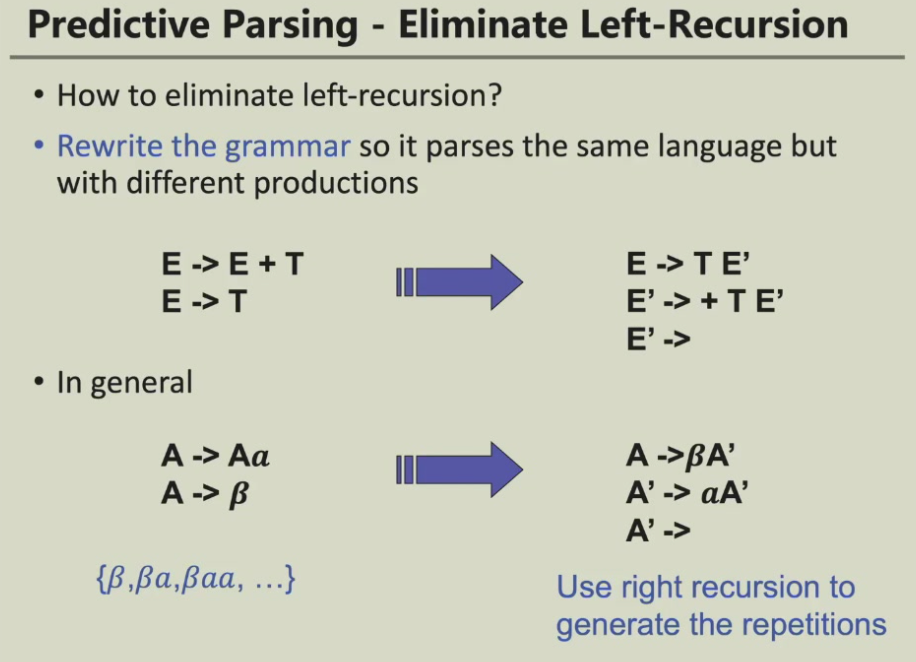
Eliminate Left-Recursion
如果 grammar 存在形如这样的形式,那么在 LL(1) parsing table 中必然会引入多重定义的项
- E -> E + T
- E -> T
解决方法比较 tricky,可以在不改变 grammar 接受的 language 的情况下改变 parsing table,需要记忆一下这个 pattern 如下:
Left Factoring
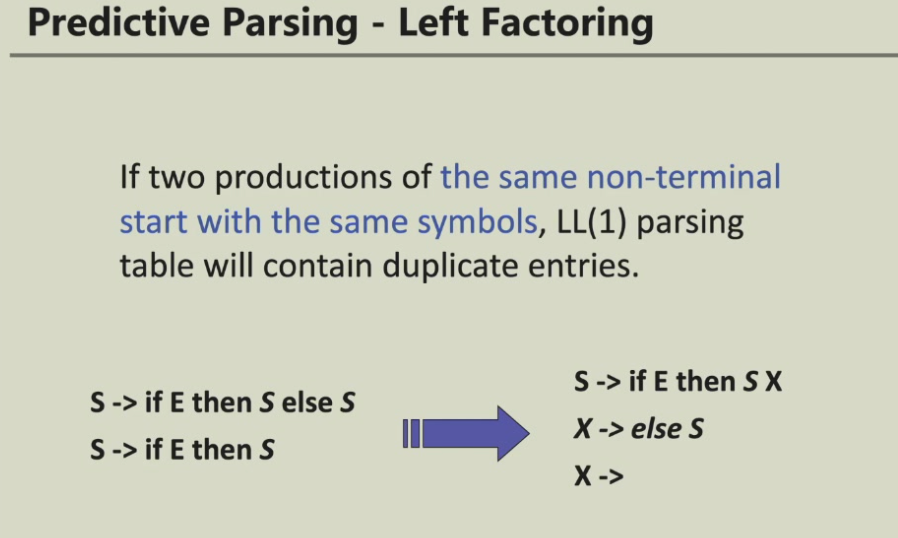
如果有两条文法共用一个“左部”,例如
- S -> if E then S else S
- S -> if E then S
我们会发现肯定会引入多重定义的项,比如遇到 if 不知道选择哪一条 production
此时可以将 grammar 改写为:
- S -> if E then S X
- X -> else S
- X ->
Error Recovery
在实际的语法分析器中,需要处理语法错误;且我们发现当存在多个语法错误时,实际编程中的这些编译器都会把所有错误都报出来,而不是一遇到语法错误就 break
大致存在两种常用方式
- inserting:文法分析器插入一个合适的 token,假设匹配对了;但假想的 token 串可能会无法 terminate,不常用
- deleting:跳过一些 tokens 直到遇到 FOLLOW set 中的 token,更安全
Bottom-Up Parsing
- LL(k) parsing is efficient and ez to write by hand
- But such math-derived parsing is not powerful enough for certain grammar
因此我们需要 LR(k) parsing,这也是现代编译器更常用的 parsing 方法
- LR(k) parsing: The most prevalent type
- Shift-Reduce Parsing
- More powerful than LL(k) parsing: able to postpone the decision (rather than only predict using top-k tokens) until it has seen input tokens corresponding to the entire right-hand side of the production in question
- LR(k): Left-to-right parse; Rightmost derivation; k-token lookahead
- Variant: LALR (Look-Ahead LR) parsing:
- basis for parsers of most modern programming languages (implemented in tools such as Yacc)
大致思想如下:
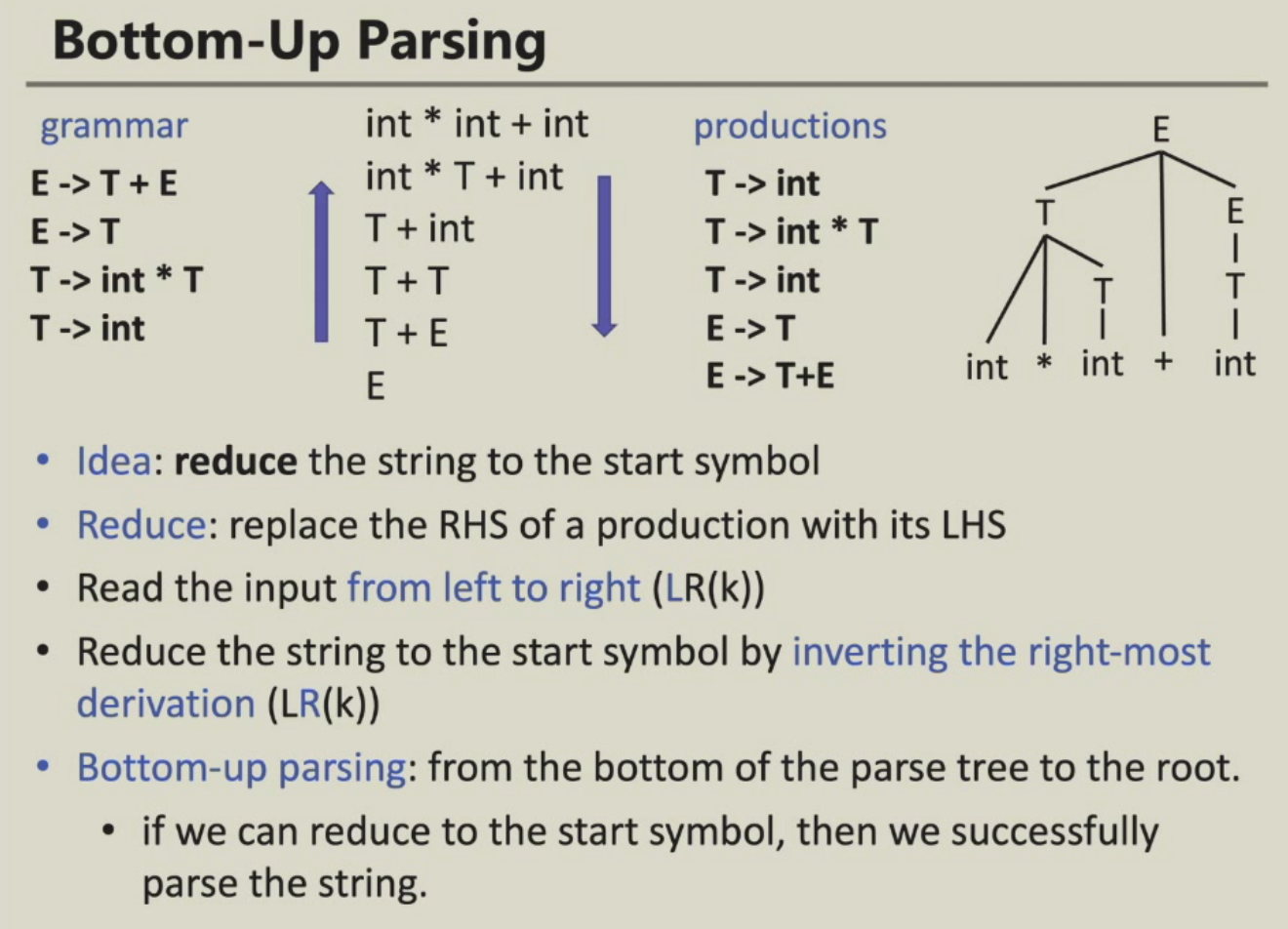
可以发现 LR Parser 如何确定什么时候做 shift,什么时候做 reduce 是很重要的(例如 int * int + int 选择 reduce 第二个 int 为 T)
LR(0) Parsing
LR(0) grammars are those can be parsed looking only at the stack, making shift/reduce decisions without any lookahead
对于 LR(0) 而言,如何做 shift/reduce 的决定呢?
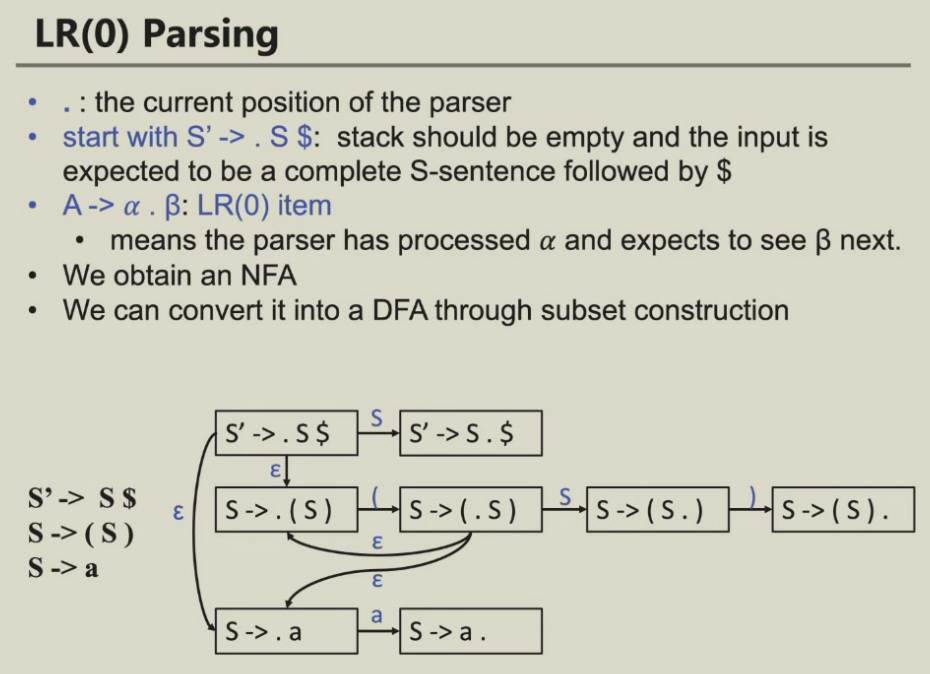
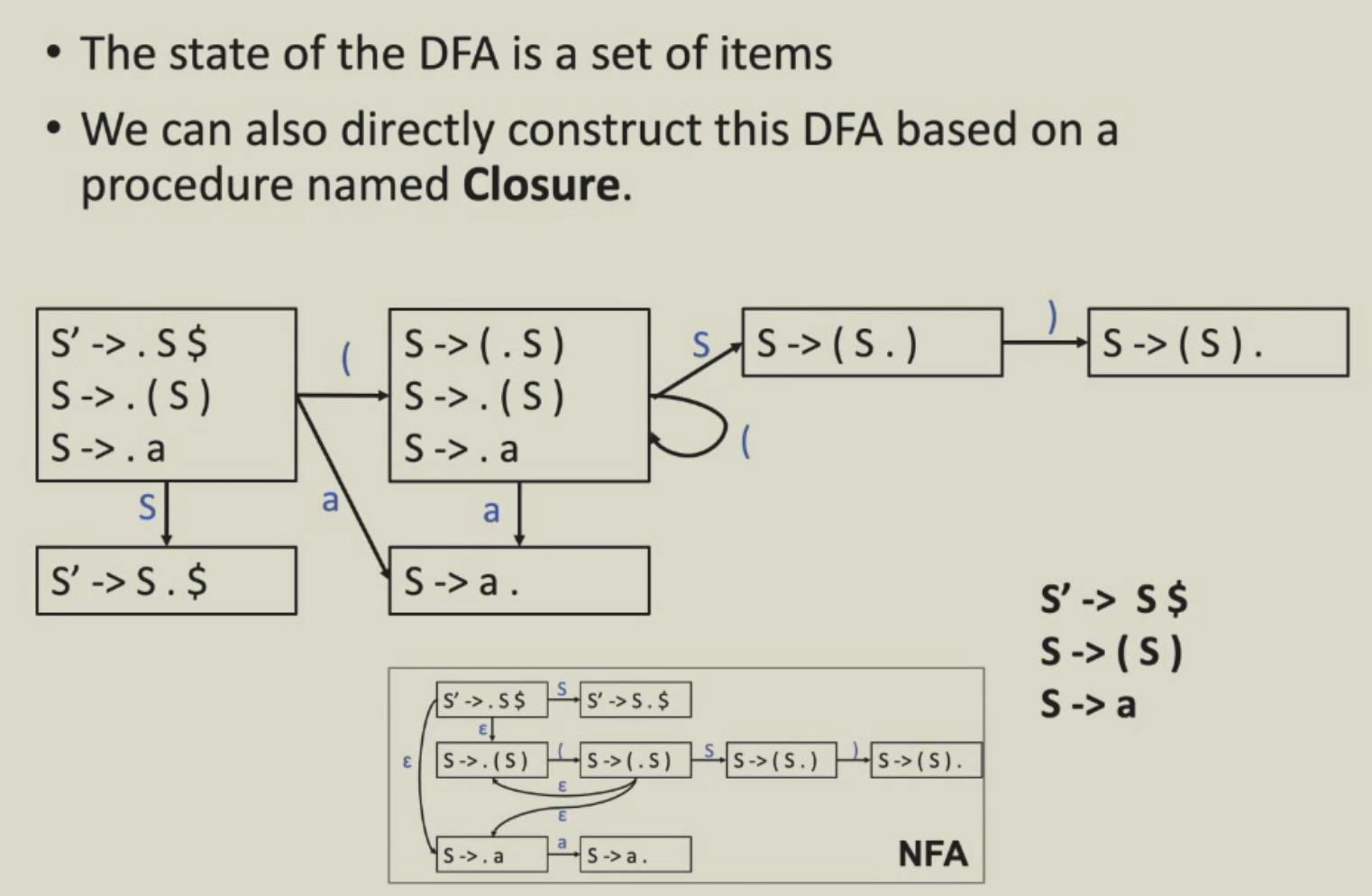
借助 DFA 来构造 Parsing Table(summarize the "parsing state" and enumerate all valid parsing states and the transitions between them based on the grammar)
首先构造一个 NFA:
然后转换为 DFA:
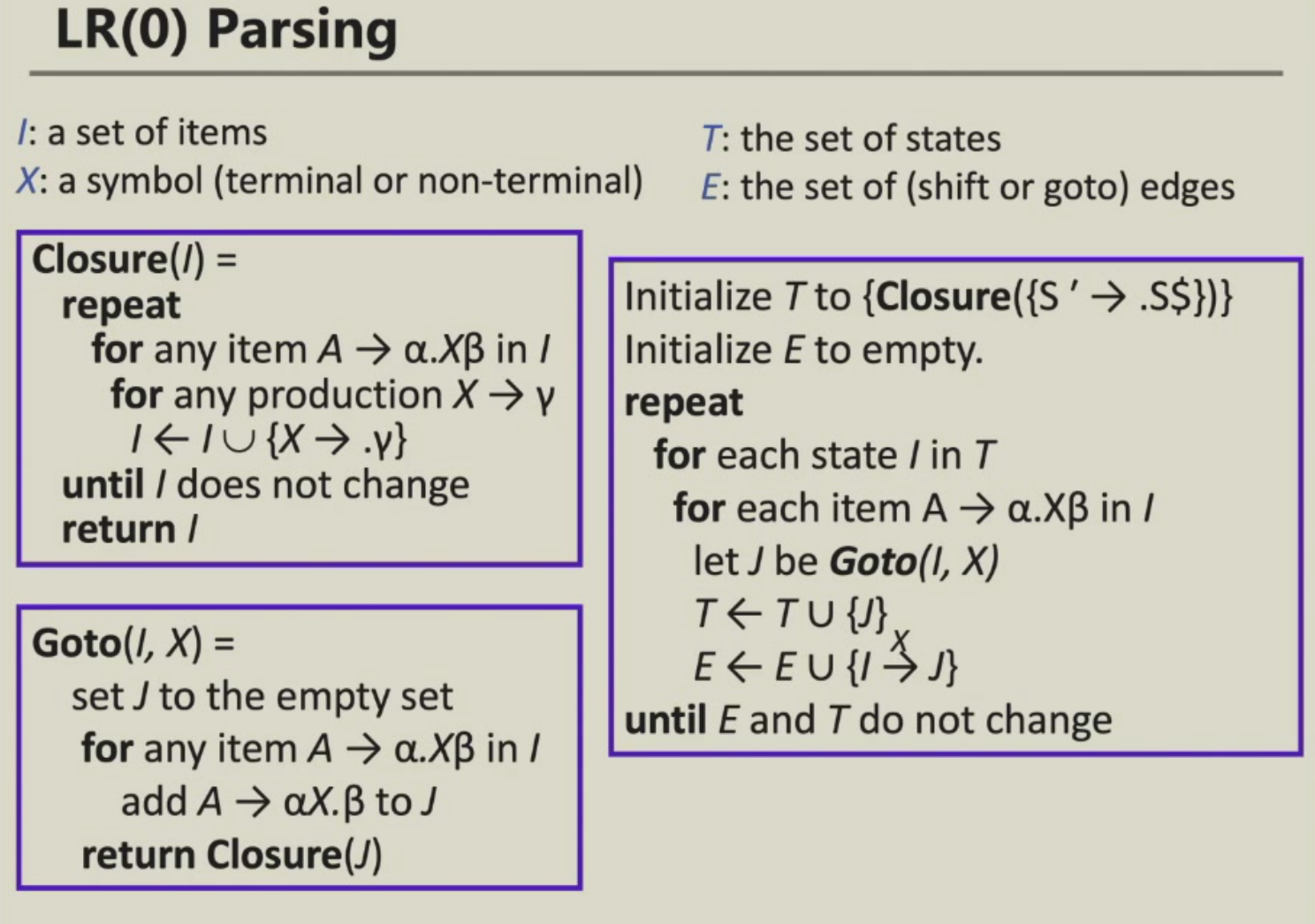
上述过程的形式化算法归纳如下(事实上可以直接按照这个算法去构造 DFA
然后就可以构造 LR(0) Parsing table 如下(好难😭
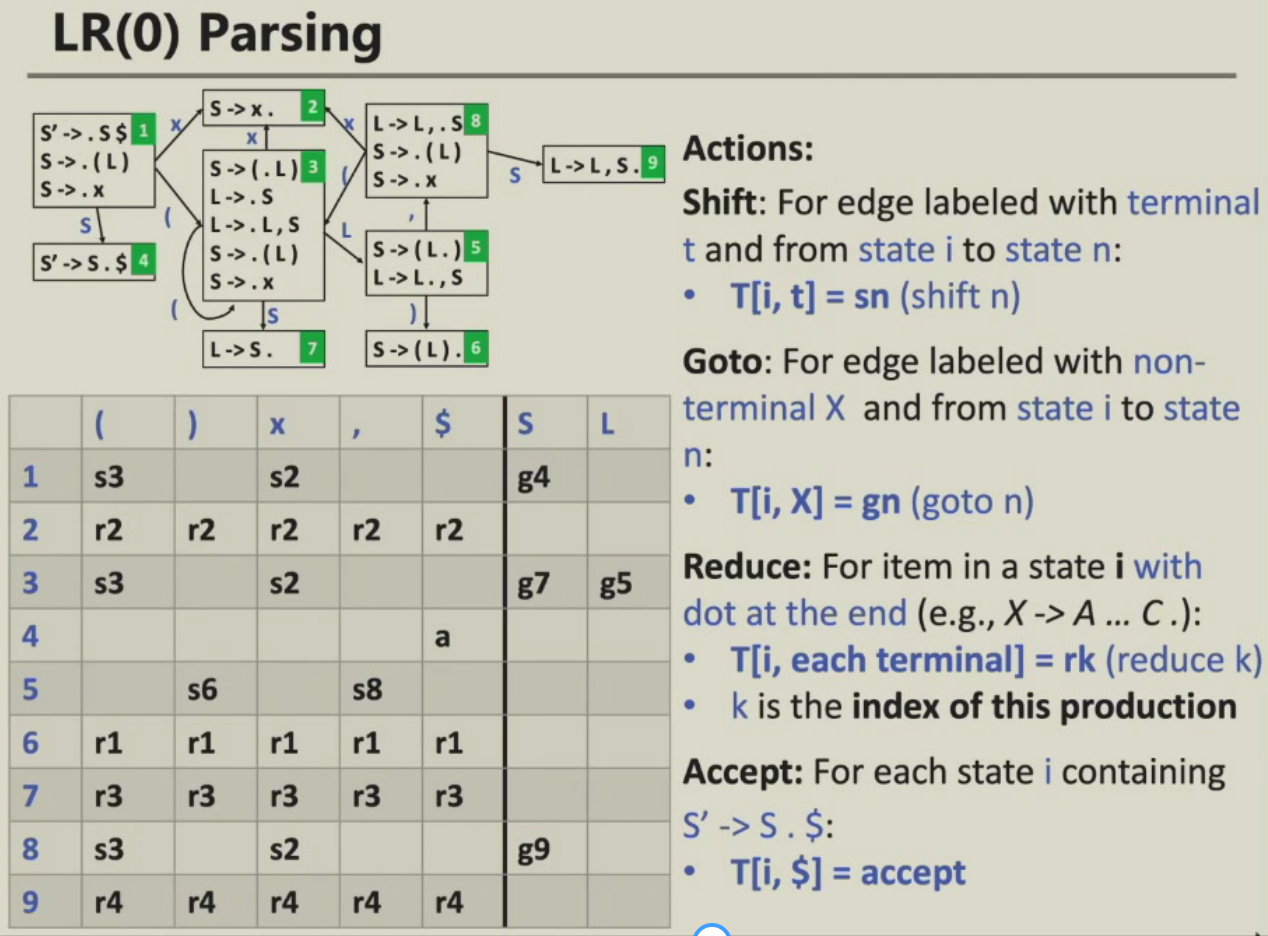
计算机只需要模拟一个栈,通过栈和这个 LR(0) table 来进行语法分析:
-
如果查到
shift n- 把当前输入符号压栈
- 把状态 n 压栈
- 输入指针前进一步
-
如果查到
reduce A -> β-
按
β的长度弹栈 -
看新的栈顶状态
s -
查
GOTO[s, A] -
把
A和新状态压栈 -
输入指针不动
-
-
如果查到
accept- 分析成功
-
如果查到空格 / error
- 语法错误
当然,LR(0) 解析文法的能力还不够强,有些时候填完的文法分析表里会有多重定义的项,比如在某一个状态遇到某一个 token 时,既可以选择 shift 也可以选择 reduce -- 也称为 shift-reduce conflict
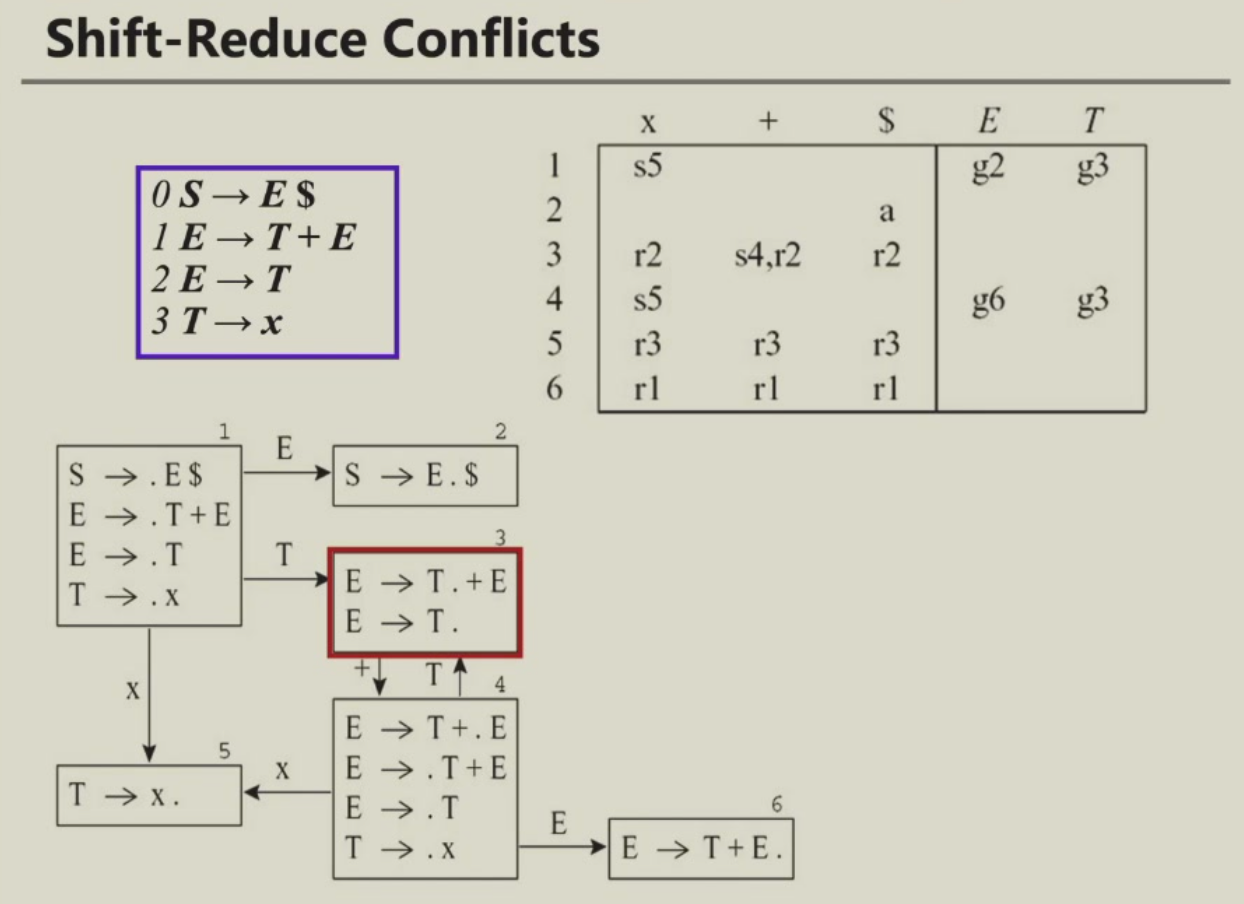
但是有些 shift-reduce conflict 是比较好解决的,比如下图中,如果在状态 3 遇到 token "+",做 r2 reduce 把 T reduce 为 E(此时栈顶为 E
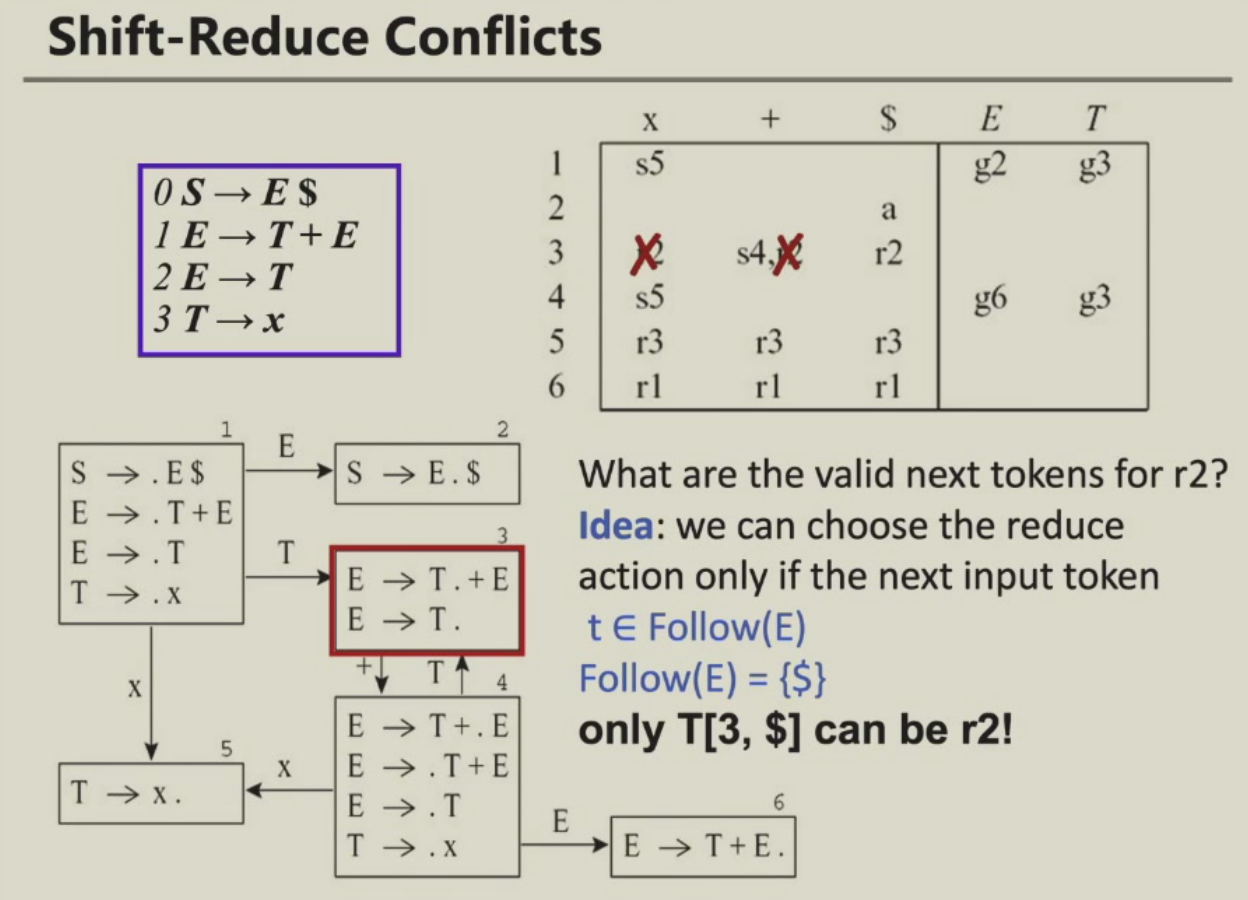
因此我们可以用这种方法减少一些实际上可以避免的 shift-reduce 冲突,为此我们引入了 SLR Parsing
SLR Parsing
SLR Parsing: Simple LR Parsing
-
Put reduce actions into the table only where indicated by the FOLLOW set
-
简而言之就是填 reduce 的操作时注意一下 reduce 回的 Non-Terminals 的 FOLLOW 集合是否包含当前遇到的 token
LR(1) Parsing
当然 SLR Parsing 解析文法的能力还不够强,为此又引入了 LR(1) Parsing
- Idea: add more information into the state of DFA so that we can resolve the conflicts!
- An LR(1) item consists of a production, a right-hand-side position (represented by the dot), and a lookahead symbol
与 LR(0) 不同的是,Closure/Goto/Reduce 变化如下:
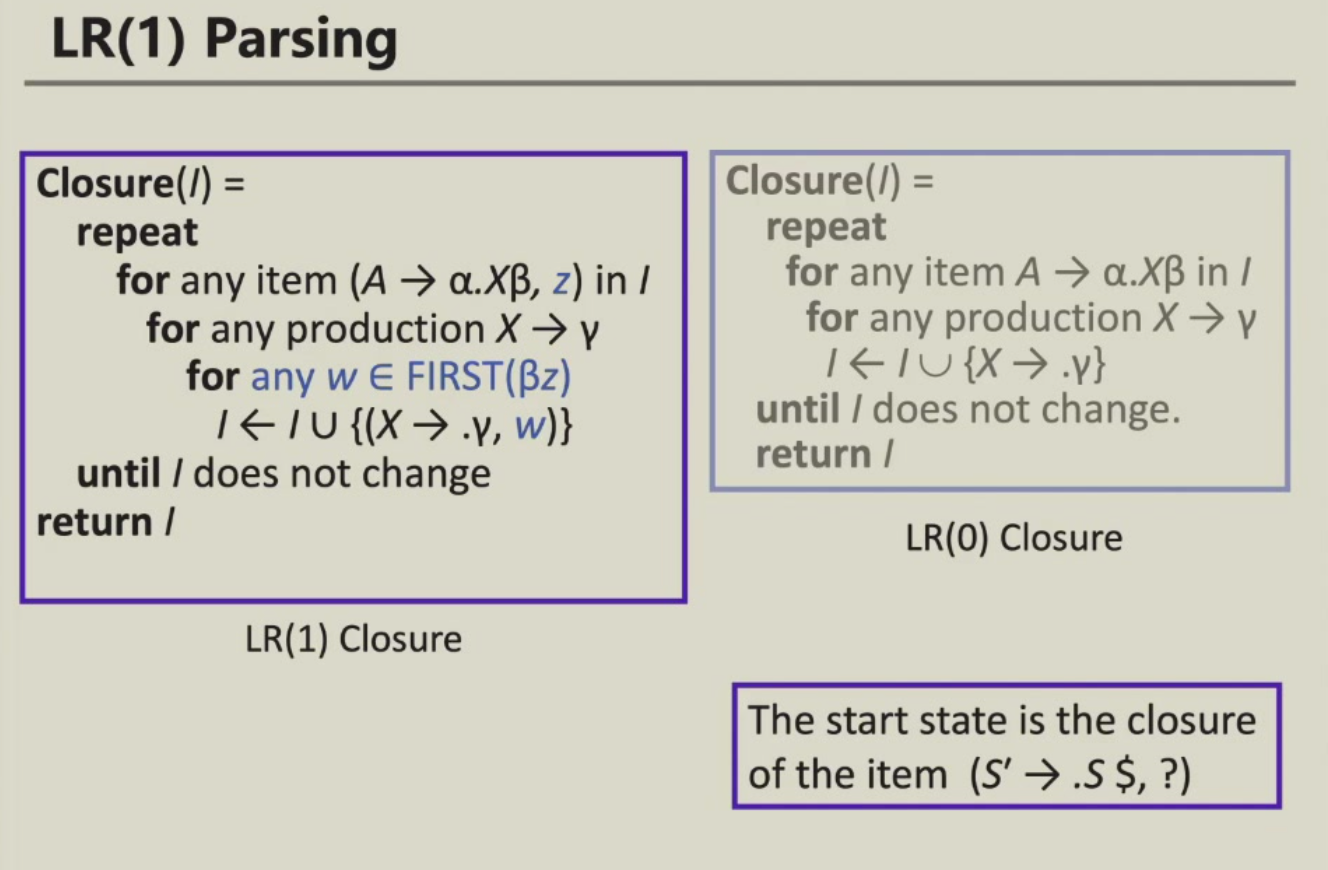
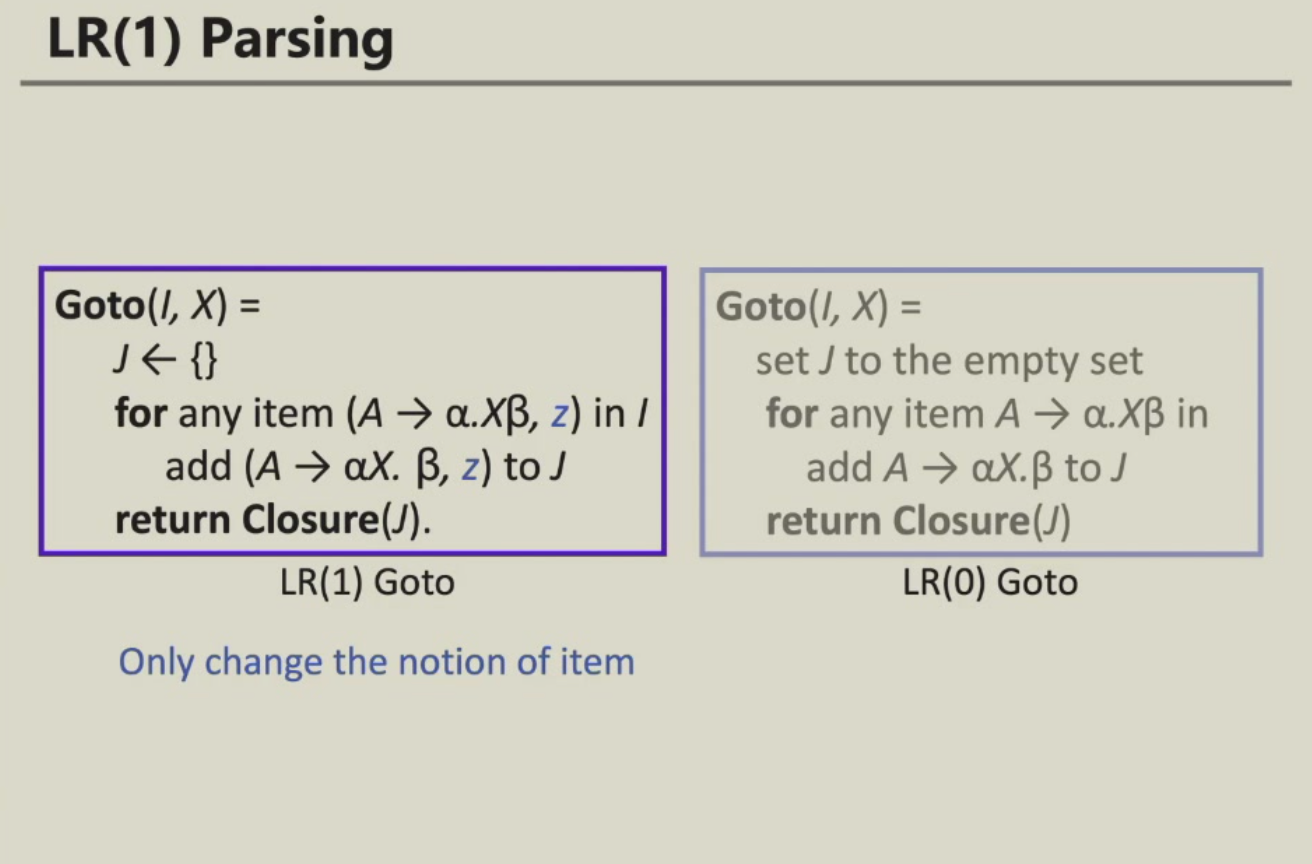
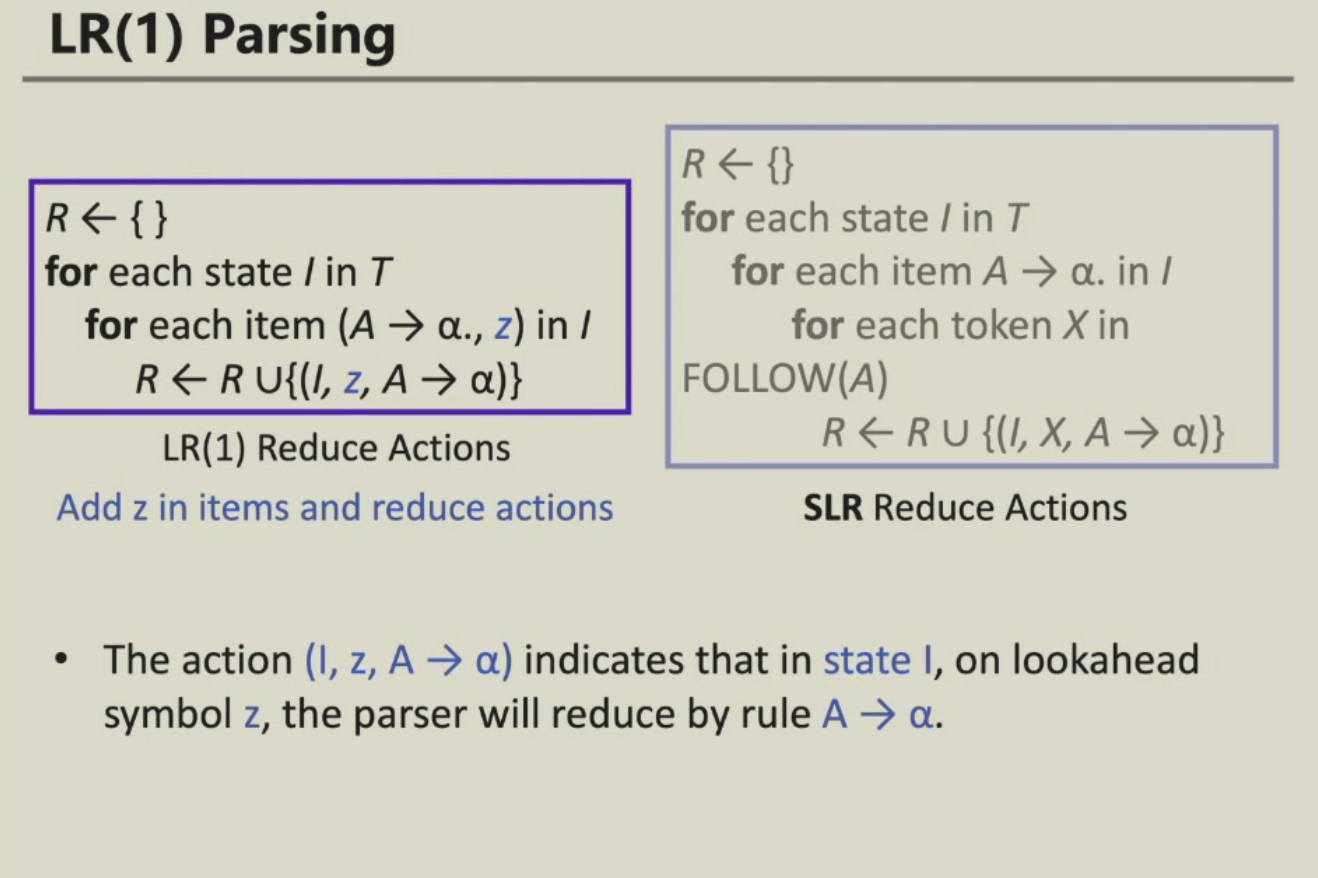
LR(1) Parsing 初始的 Closure 如下:
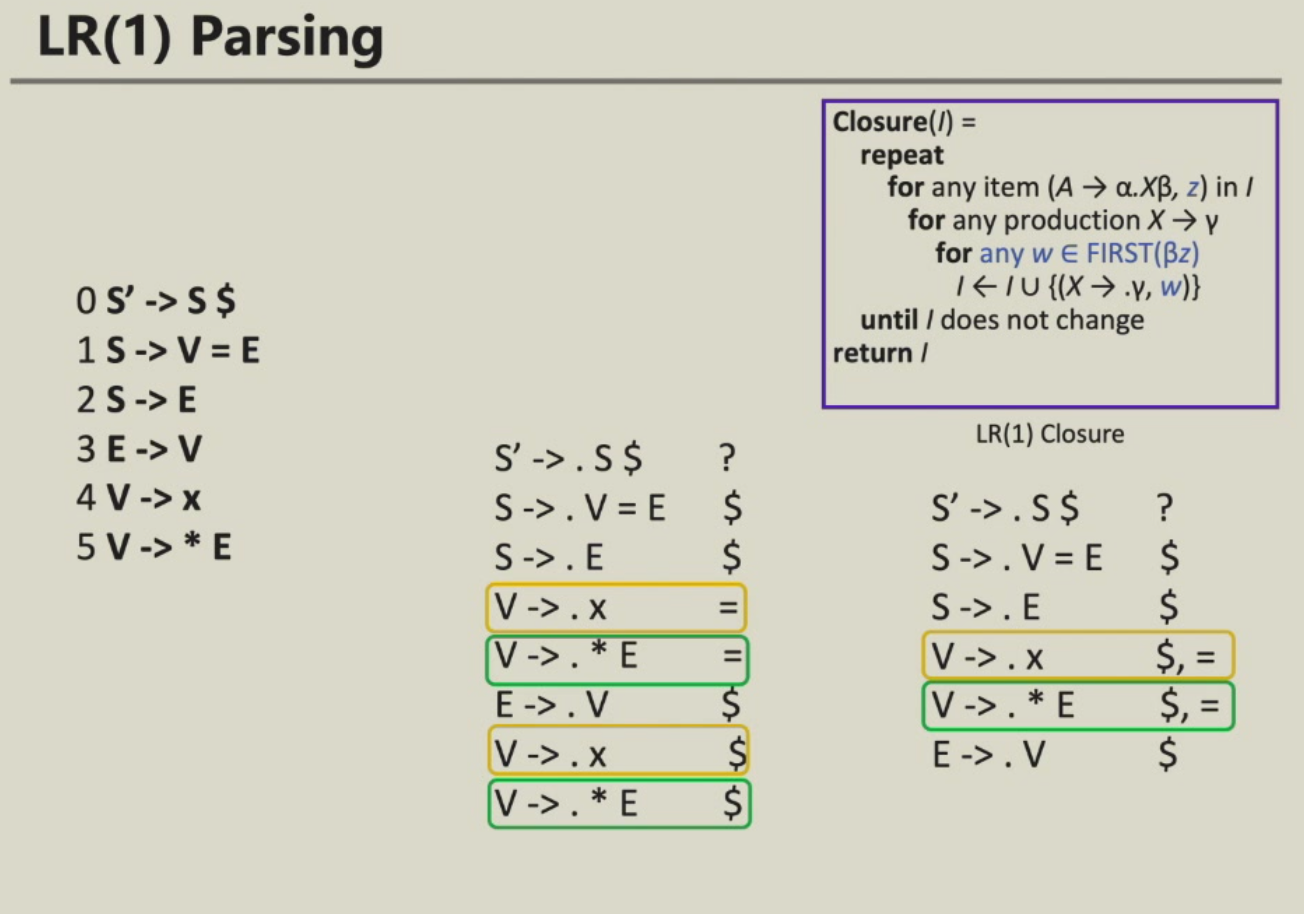
该例子构造的 DFA 如下:
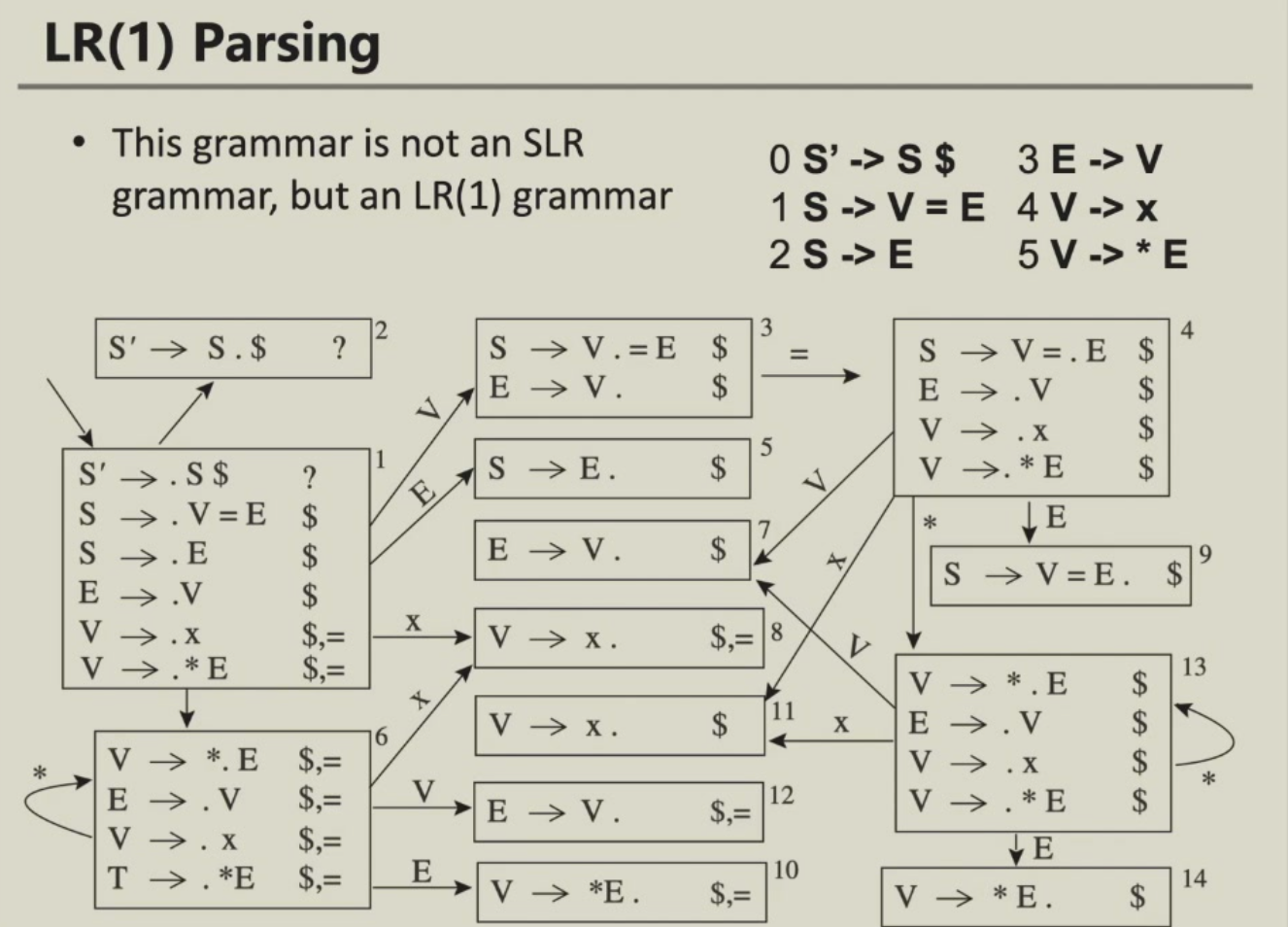
Parsing Table 如下:
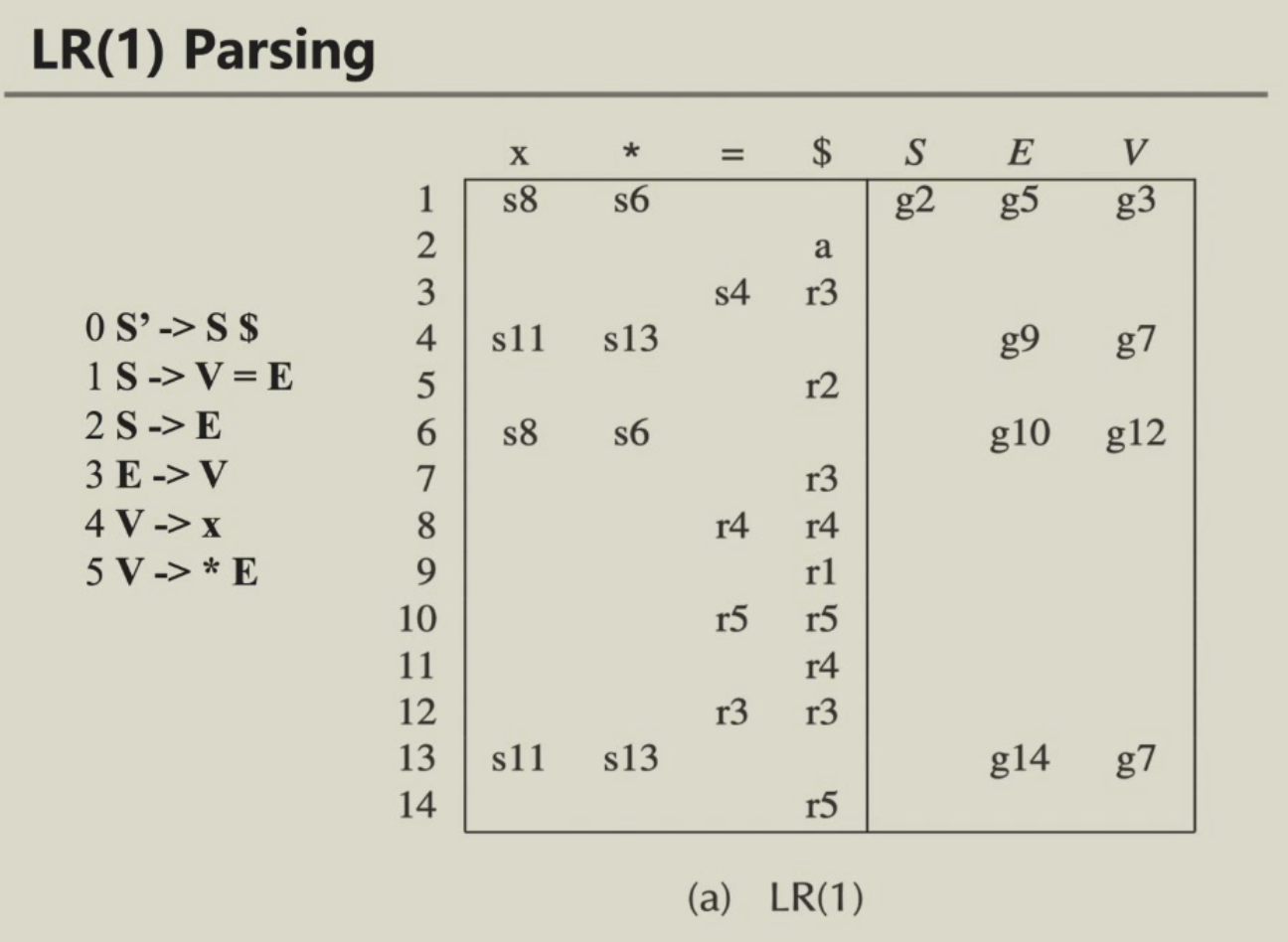
Note
LALR(1) 将 LR(1) 中生成式相同,lookahead 不同的状态合并,能力更弱,但状态数更少,实际使用中更常用,例如 YACC
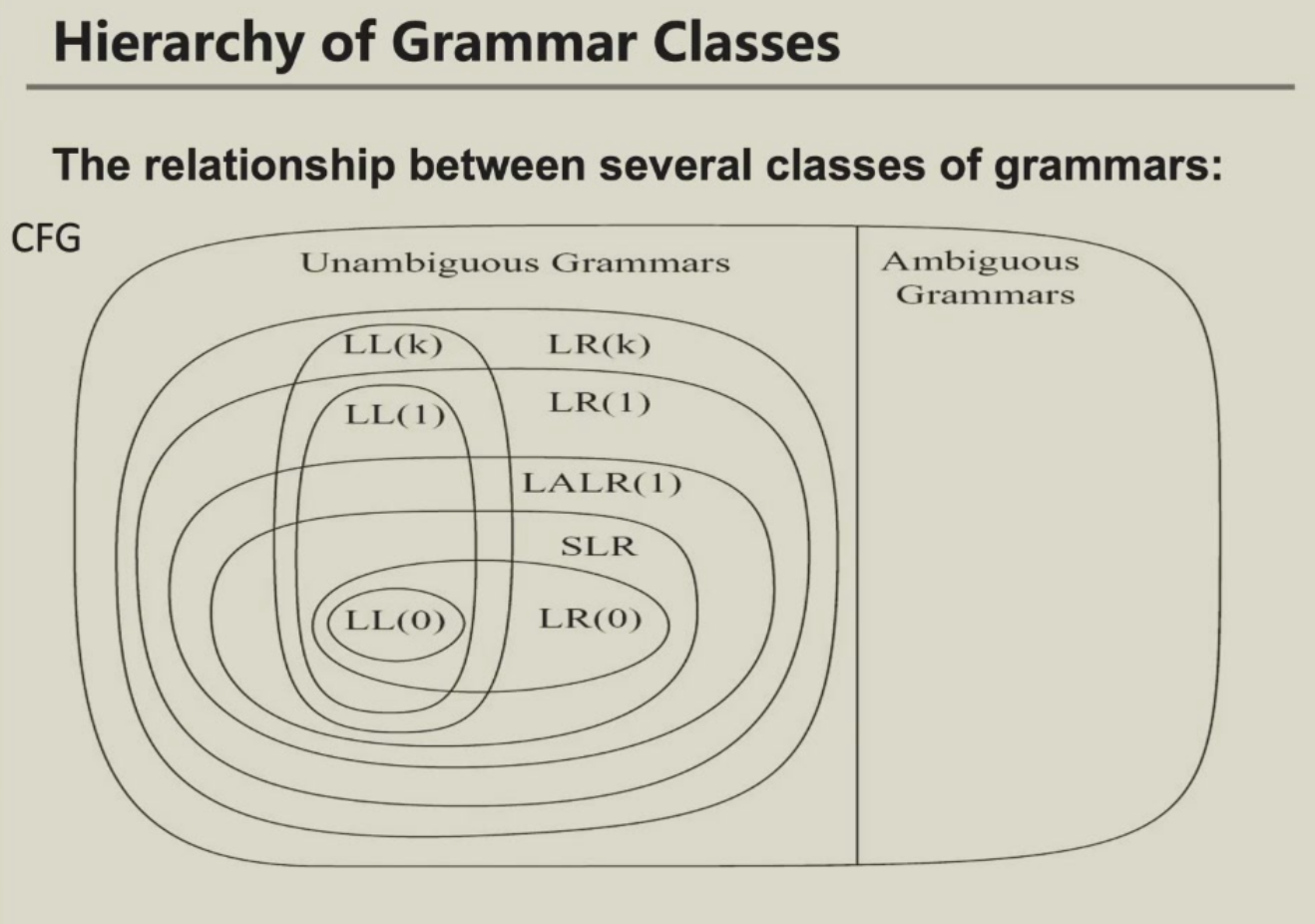
Hierarchy of Grammar Classes
Parser Implementation
We can implement a parser in two ways:
- Write a parser from scratc
- Use a parser generator
graph LR
A[Parser Specification] -- Parser Generator --> B[Parser]
Note
Yacc: Yet another compiler-compiler
- Input: A specification file (usually with a suffix .y)
- Output: An output file consisting of C source code for the parser (usuallly with a suffix tab.c -- referred to the LALR Parsing Table)
Error Recovery
略
- Local Error Recovery
- Global Error Recovery