Attention
约 2609 个字 8 张图片 预计阅读时间 26 分钟
Attention 可以用来解决上面 RNN 的 bottleneck
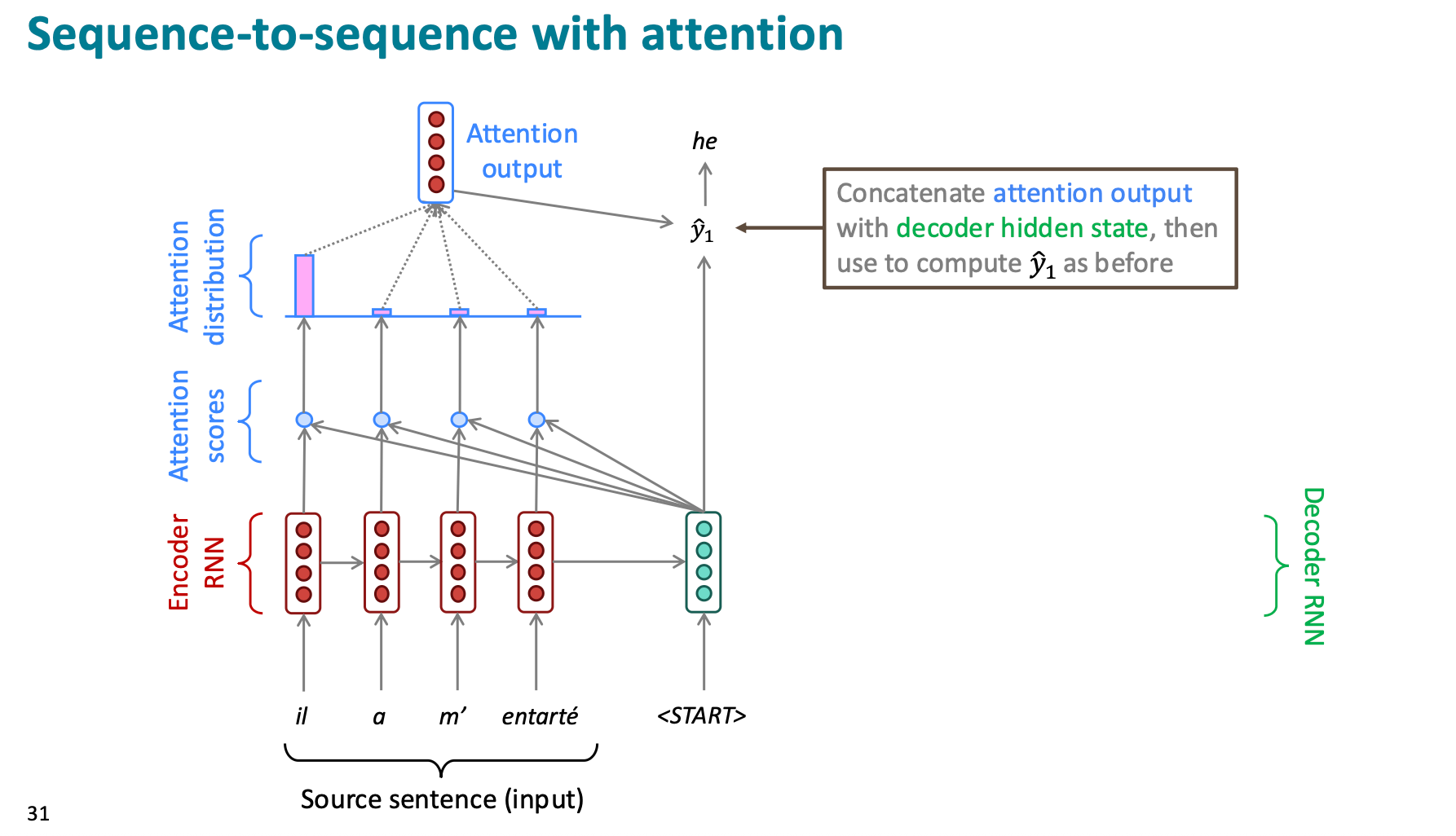
Core idea: on each step of the decoder, use direct connection to the encoder to focus on a particular part of the source sequence
用上 attention 机制后,原先的 seq-to-seq 的 decoder/encoder RNN 的架构如下:
-
We’ve seen that attention is a great way to improve the sequence-to-sequence model for Machine Translation.
-
However: You can use attention in many architectures (not just seq2seq) and many tasks (not just MT)
- More general definition of attention:
- Given a set of vector values, and a vector query, attention is a technique to compute a weighted sum of the values, dependent on the query.
- We sometimes say that the query attends to the values.
- For example, in the seq2seq + attention model, each decoder hidden state (query) attends to all the encoder hidden states (values)
思考一下,抽象的来说,Attention 是一种 general 的用于表征一整个 sequence 序列的方式,RNN ( 把先前 sequence 表征为 hidden state 的思想)又何尝不是如此呢?换句话说,它们本质上都是一种把序列信息传给当前位置表示的方法
而既然 Attention 可以更直接、更并行地传递序列信息,那我们能不能完全去掉 RNN,用 Attention 来建模序列?答案是可以的!
Self-Attention
前面在 Machine Translation 里看到的 attention 更准确地说是 cross-attention:
- query 来自 decoder 当前 hidden state
- key/value 来自 encoder 的所有 hidden states
- 也就是 decoder 在生成当前词时,回头看 source sentence 的不同位置
而如果我们想完全去掉 RNN,就需要让一个序列内部的 token 彼此交换信息,这就是 self-attention
Important
Cross-attention: query 和 key/value 来自不同序列
Self-attention: query, key, value 都来自同一个序列
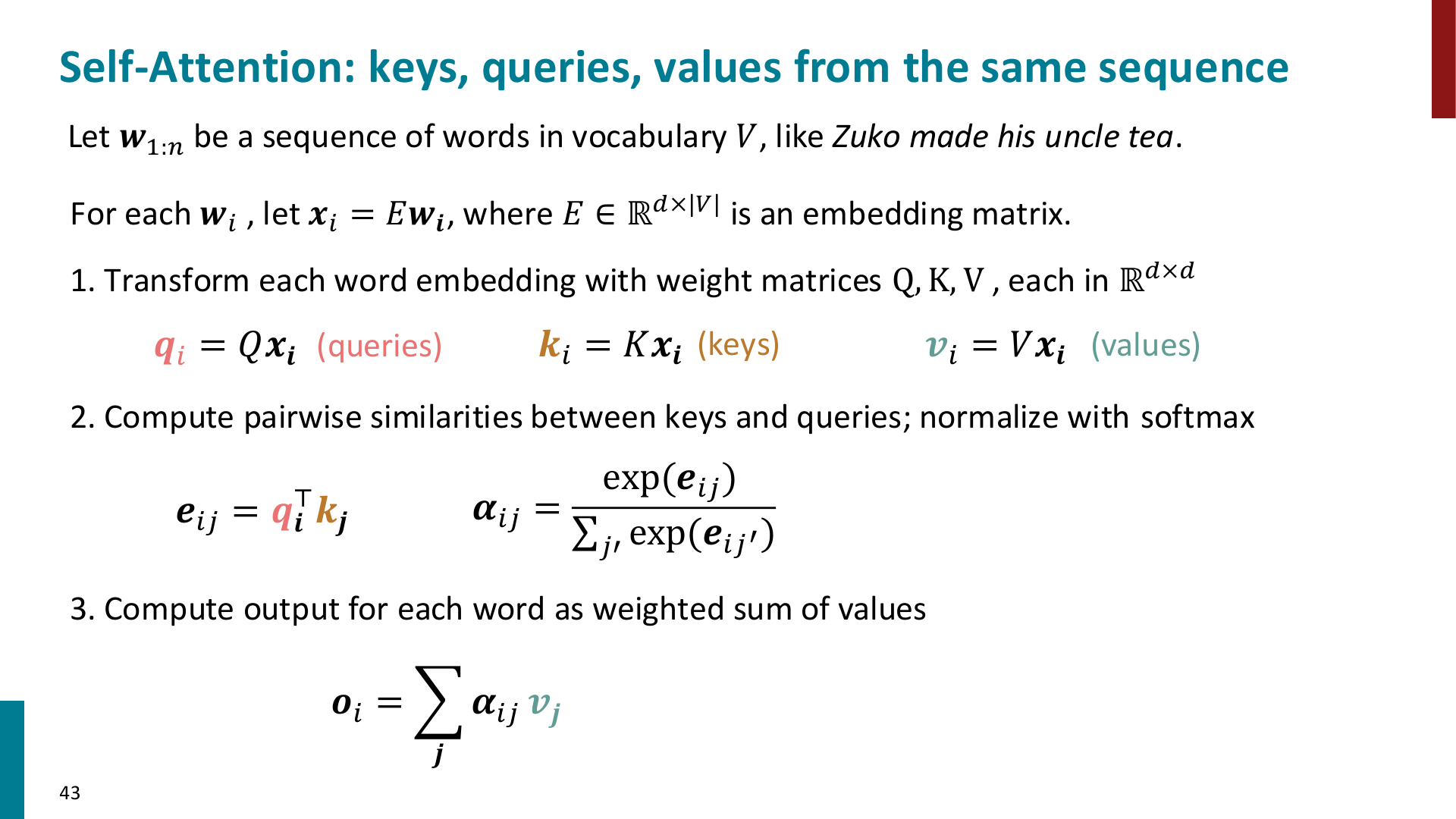
对于一个输入序列 \(w_1,\dots,w_n\),先把每个 word 转成 embedding:
然后对每个位置的 embedding 分别做三个线性变换:
其中:
- \(q_i\) 是 query:当前位置想要找什么信息
- \(k_i\) 是 key:某个位置提供的信息可以被怎样检索
- \(v_i\) 是 value:某个位置真正要被取走、加权平均的内容
接着用 query 和 key 的 dot product 来计算位置 \(i\) 对位置 \(j\) 的 attention score:
然后对所有 \(j\) 做 softmax:
最后用 attention distribution 对所有 value 做加权平均:
也就是说,\(o_i\) 是第 \(i\) 个位置在看完整个序列后得到的新表示
Tip
可以把 self-attention 理解成:每个 token 都发出一个 query,去和句子里所有 token 的 key 做匹配,然后按照匹配程度把所有 token 的 value 加权平均回来。
因此 self-attention 的输出不是单纯的 word embedding,而是一个已经融合了上下文信息的 contextual representation。
Matrix form of self-attention
为了并行计算,我们通常把所有 token 的向量堆成矩阵:
那么:
self-attention 可以写成:
这里 \(QK^\top \in \mathbb{R}^{n\times n}\),它包含了所有 token pair 之间的 attention score
Important
这也是 self-attention 的一个重要计算特征:它要计算所有位置两两之间的关系,因此 attention matrix 的大小是 \(n\times n\),计算量和显存都会随序列长度呈 quadratic growth。
Why position representation is needed?
Self-attention 本身没有内置顺序信息。
例如只看一组 unordered embeddings 时,self-attention 并不知道 the cat chased the dog 和 the dog chased the cat 的位置差异,因为它只是在做 query-key matching 和 weighted average
因此我们需要把 position information 加到 token representation 里:
其中 \(p_i\) 是第 \(i\) 个位置的 position vector
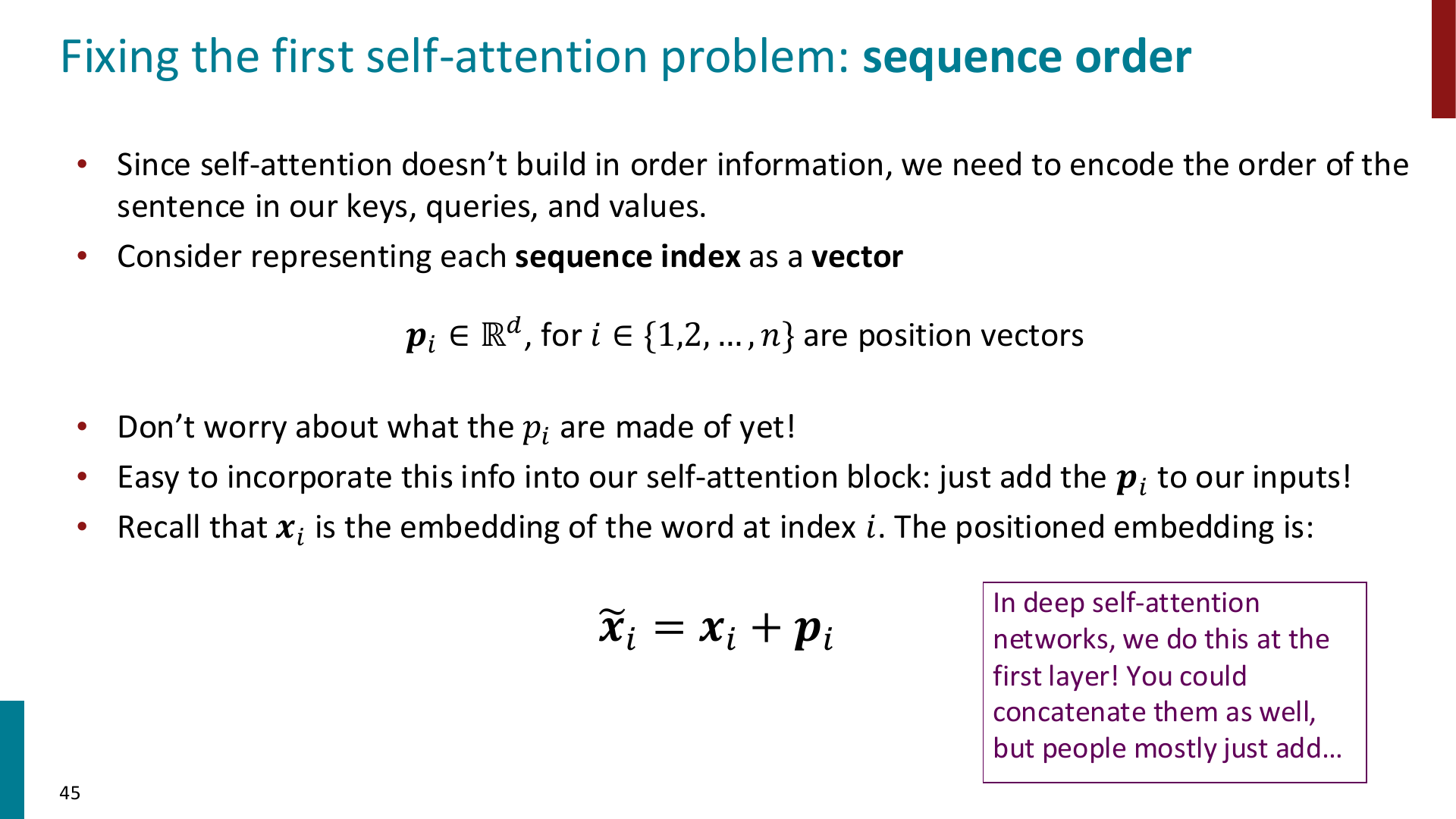
课件里主要提到两种 position representation:
- Sinusoidal position representation
- 用不同周期的 \(\sin\) 和 \(\cos\) 函数构造位置向量
- 优点是形式固定,理论上对更长序列有一定 extrapolation 的直觉
- 缺点是不可学习,实际 extrapolation 效果也不一定好
- Learned absolute position representation
- 把每个位置 \(p_i\) 当成可学习参数
- 优点是灵活,能根据训练数据调整
- 缺点是不能自然泛化到训练时没见过的更长位置
Tip
在 Transformer 里,word embedding 只告诉模型“这个 token 是什么”,position embedding 告诉模型“这个 token 在哪里”。
两者相加后,模型才同时知道 token identity 和 token order。
Adding nonlinearities
Self-attention 的核心操作是 weighted average,本身没有 element-wise nonlinearity。
如果只是堆很多层 self-attention,本质上容易变成不断重新平均 value vectors,因此 Transformer block 会在 attention 后面接一个 feed-forward network:
这个 FFN 是 position-wise 的:
- 每个位置都用同一套 FFN 参数
- 不同位置之间的信息交换已经由 self-attention 完成
- FFN 的作用是对每个位置自己的表示做非线性变换
Masking the future
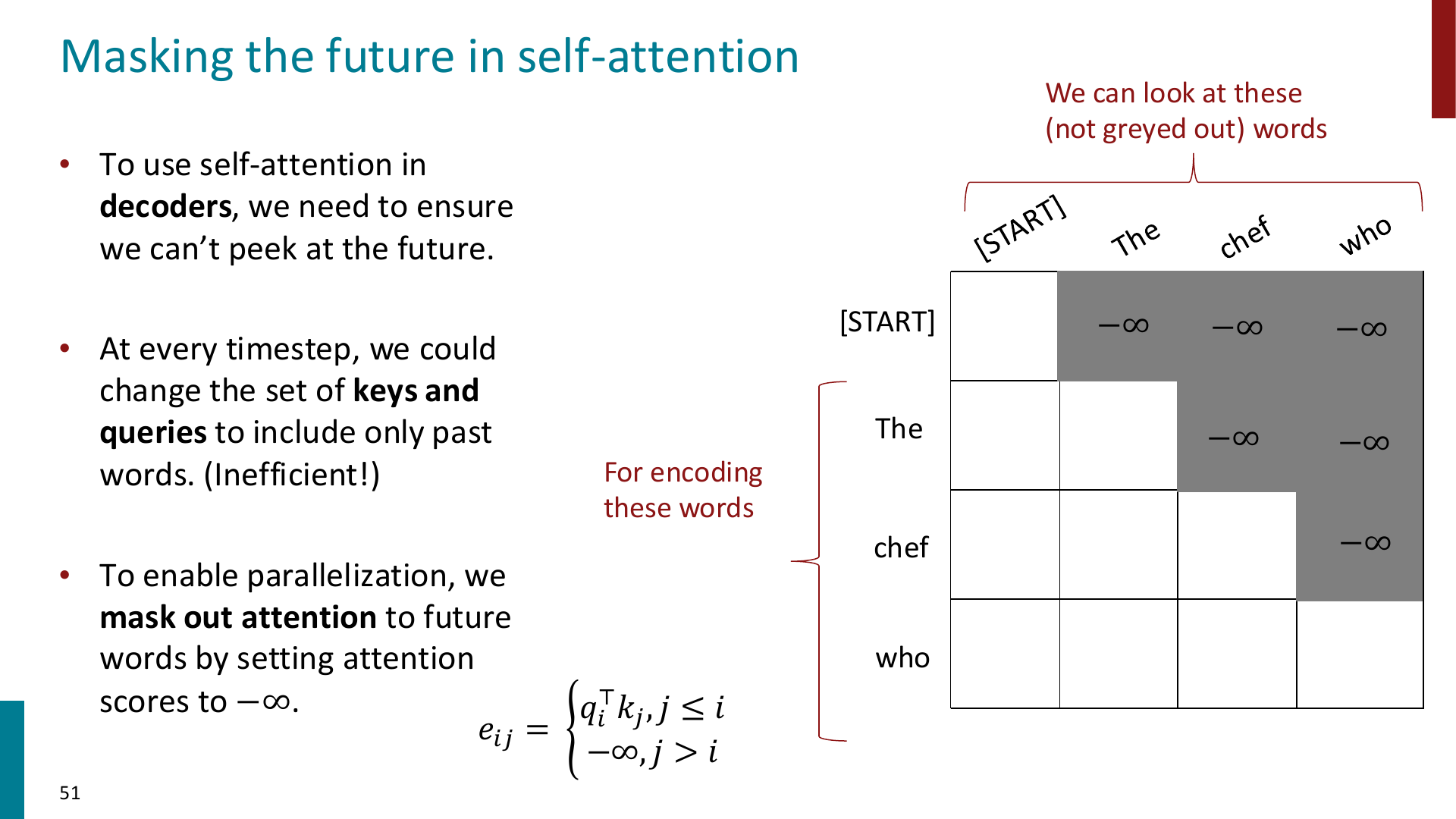
如果用 self-attention 做 language modeling 或 decoder,我们在预测第 \(i\) 个位置时不能看到未来的 token
例如预测 The chef who ... 的下一个词时,模型不能偷看后面的 ground-truth word,否则训练目标就泄漏了
解决方法是 causal mask:
这样做 softmax 时,未来位置 \(j>i\) 的 attention weight 会变成 0
Important
Masking 的意义不是让模型一个 timestep 一个 timestep 地慢慢算,而是为了在训练时仍然可以并行计算整个序列,同时保证每个位置只 attend to 它之前的 token。
Multi-Head Attention
单个 attention head 只能用一套 \(W_Q,W_K,W_V\) 去决定“看哪里”和“取什么信息”
但一个 token 可能同时需要关注多种关系:
- 语法上的主谓宾关系
- 指代关系,例如
his指向谁 - 局部短语结构
- 长距离依赖
因此 Transformer 使用 multi-head attention:让多个 attention heads 并行工作,每个 head 使用自己的一套 \(W_Q,W_K,W_V\)
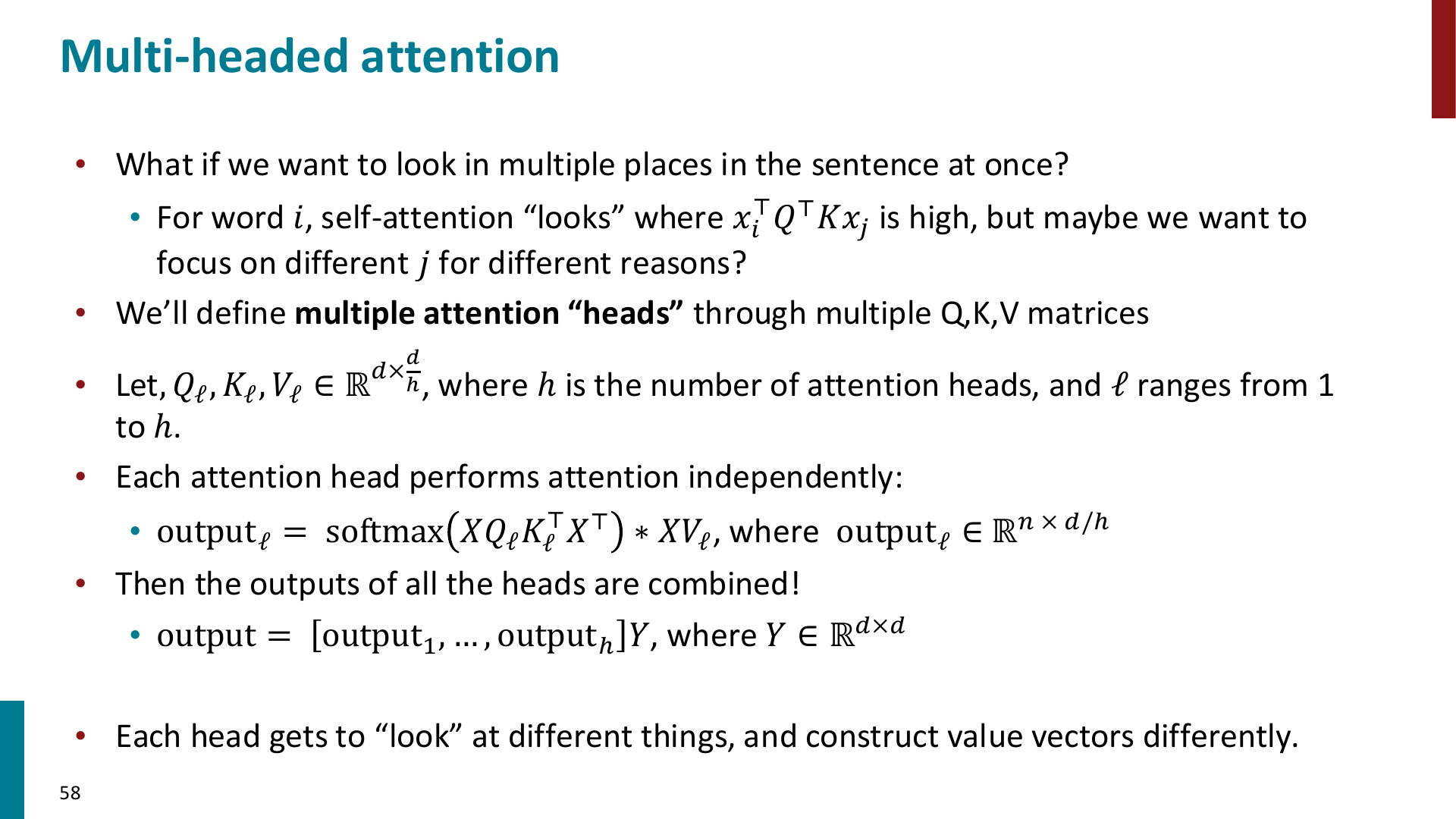
设一共有 \(h\) 个 heads,每个 head 的维度是:
第 \(\ell\) 个 head 计算:
然后把所有 heads 的输出 concatenate 起来,再过一个线性层:
Tip
Multi-head attention 不是简单地把同一种 attention 算很多遍,而是给模型多个“视角”。
不同 head 可以学习关注不同类型的依赖关系,最后再把这些信息合并起来。
Scaled dot-product attention
当 \(d_h\) 很大时,query 和 key 的 dot product 容易变得很大
如果 softmax 的输入过大,分布会变得过于尖锐,梯度容易变小,不利于训练
所以 Transformer 使用 scaled dot-product attention:
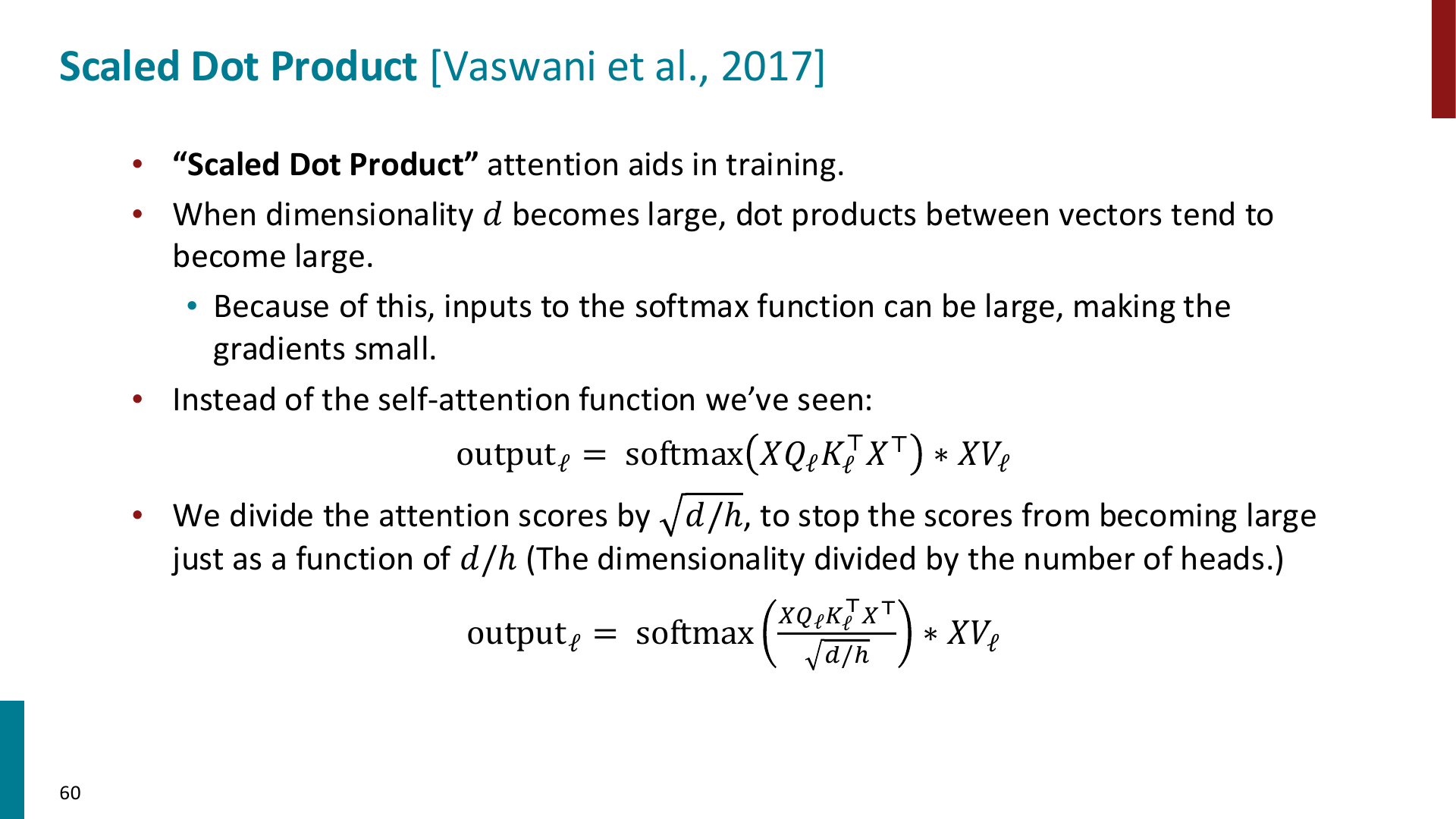
其中 \(d_k\) 是 key/query 的维度。在 multi-head attention 里,一般有:
Important
除以 \(\sqrt{d_k}\) 不是改变 attention 的思想,而是为了让 attention scores 的数值尺度更稳定,使 softmax 不至于太容易饱和。
Transformer
Transformer 的核心思想可以概括为:
用 self-attention 代替 recurrence,让每个 token 可以直接和任意位置的 token 建立联系,并且整个序列可以并行计算
Transformer Decoder
Transformer Decoder 可以用来构建 language model
输入流程大致是:
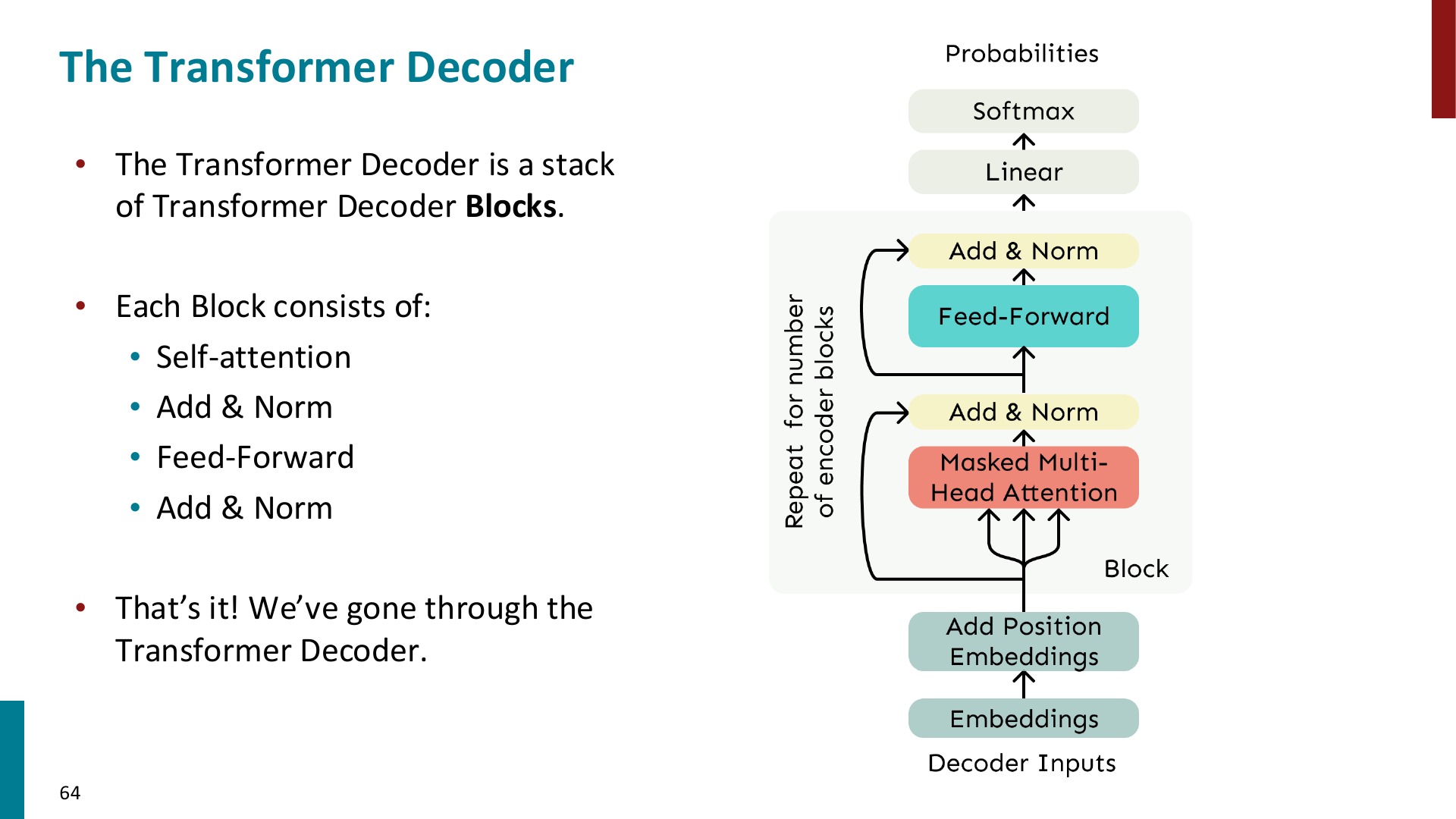
一个 Transformer Decoder Block 包含:
- Masked Multi-Head Self-Attention
- Add & Norm
- Feed-Forward Network
- Add & Norm
其中 masked self-attention 保证 decoder 只能看过去,不能看未来
Important
Decoder-only Transformer 本质上就是一个 conditional-on-prefix 的 language model:
causal mask 保证模型在预测 \(x_t\) 时只使用 \(x_{< t}\)。
Residual connection and Layer Normalization
课件里把 residual connection 和 layer normalization 合在一起叫 Add & Norm
Residual connection 的形式是:
它的直觉是:模型不需要每层都从头学习一个全新的表示,而是学习相对上一层的 residual change
Tip
Residual connection 对梯度传播也很重要,因为它提供了一条更直接的路径,让深层网络更容易训练。
Layer normalization 对每个 token 的 hidden vector 做归一化
对于 \(x\in\mathbb{R}^d\):
其中 \(\gamma,\beta\in\mathbb{R}^d\) 是可学习参数
在 Transformer block 里,Add & Norm 通常可以写成:
这里的 Sublayer 可以是 multi-head attention,也可以是 feed-forward network
Transformer Encoder
Transformer Encoder 和 Decoder 最大的区别是:Encoder 的 self-attention 不需要 causal mask
因为 encoder 的目标不是从左到右生成下一个词,而是为每个位置计算一个可以看完整输入序列的 contextual representation
所以 encoder 中每个 token 都可以 attend to:
- 左边的 token
- 右边的 token
- 自己
这就类似于 bidirectional RNN 的效果,只不过 Transformer 用 attention 直接连接所有位置
Transformer Encoder-Decoder
在机器翻译这类 seq2seq 任务中,通常使用 Transformer Encoder-Decoder
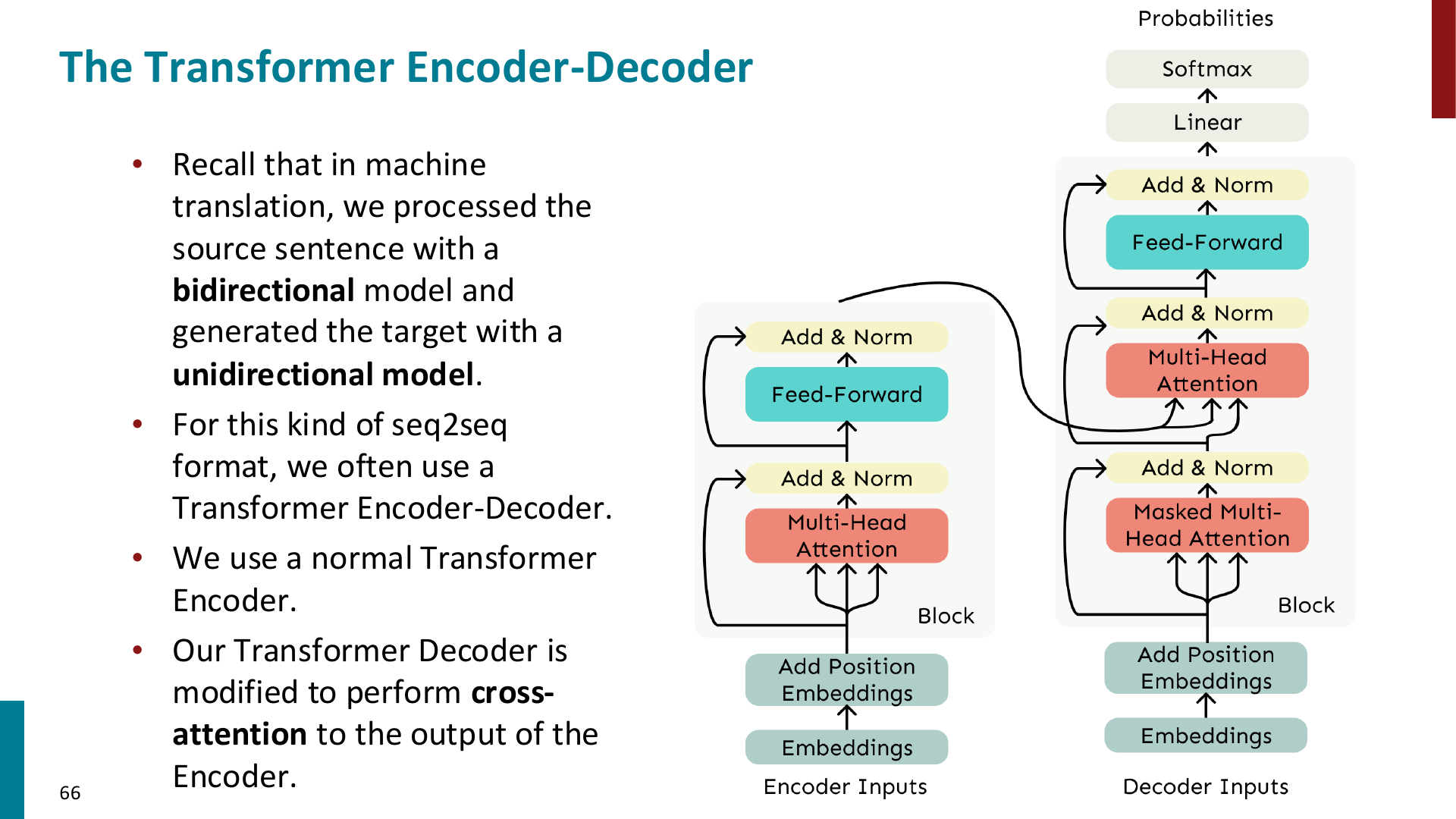
整体结构是:
- Encoder 读取 source sentence,使用 unmasked self-attention 得到 source representations
- Decoder 生成 target sentence,使用 masked self-attention 处理已经生成的 target prefix
- Decoder 额外使用 cross-attention 去看 encoder 的输出
Cross-attention 的 Q/K/V 来源不同:
其中:
- \(z_i\) 来自 decoder 当前层的 hidden states
- \(h_j\) 来自 encoder 的输出 hidden states
- 因此 query 来自 target side,key/value 来自 source side
Important
Encoder-decoder Transformer 保留了 seq2seq 的思想:
source sentence 先被 encoder 表示出来,decoder 再一边生成 target sentence,一边通过 cross-attention 对齐并读取 source sentence 的信息。
Summary of Transformer blocks
Transformer 的几个核心组件可以这样记:
- Self-attention
- 让序列内部的 token 互相读取信息
- Position embedding
- 给 attention 补上顺序信息
- Causal mask
- 用在 decoder/language model 中,防止看到未来
- Multi-head attention
- 让模型从多个不同视角关注不同关系
- Feed-forward network
- 给每个位置加入非线性变换能力
- Residual connection
- 帮助深层网络训练,让信息和梯度更容易传播
- Layer normalization
- 稳定 hidden states 的数值分布,加快训练
Transformer 相比 RNN 的关键优势是:
- 可以并行处理整个序列
- 任意两个位置之间的路径更短,长距离依赖更容易建模
- attention distribution 有一定 interpretability
但它也有一个明显代价:
- self-attention 需要计算所有 token pair 的关系,因此对长度为 \(n\) 的序列有 \(O(n^2)\) 的 attention cost